1. A Familiar World, an Unfamiliar Question
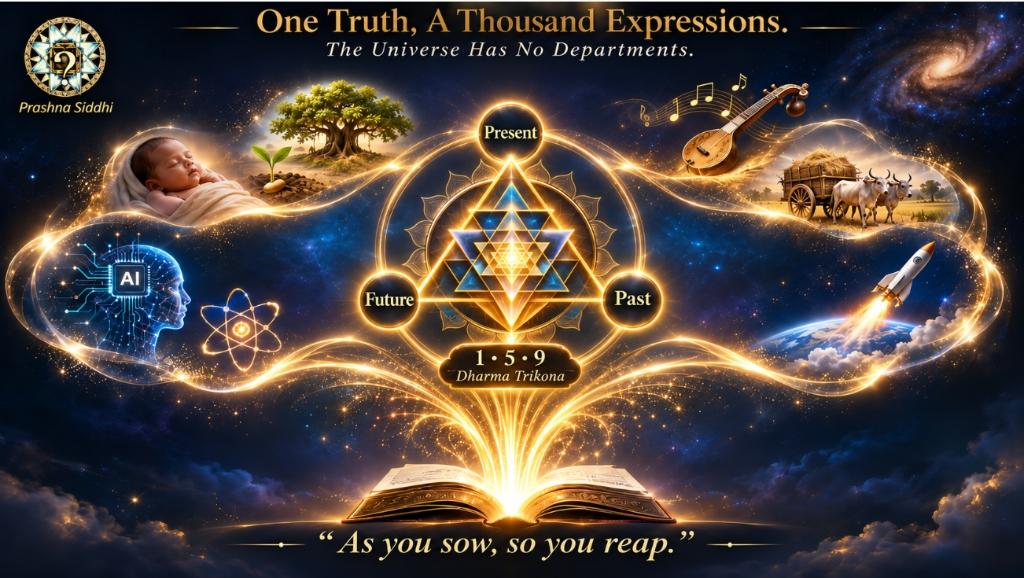
A child is born. A seed grows into a tree. A musician produces a melody. A bullock cart travels along a village road, while a rocket leaves Earth. In a laboratory, researchers investigate the behaviour of matter. Elsewhere, an artificial-intelligence system generates language from patterns learned during training.
We assign these events to different departments: biology, botany, music, engineering, physics and computer science. The divisions are useful. They allow each discipline to develop its own methods, vocabulary and standards of proof. But the divisions belong to our organisation of knowledge; the events themselves are not separated by the labels we use.
The question behind this series is simple: When we remove the lines dividing our subjects, do we begin to recognise relationships that have been there all along?
2. Present, Past and Future: The Doorway
Every event has a present condition, a history from which it emerged and a range of possible futures. These are not three sealed compartments. The past leaves traces in the present; present actions alter the possibilities of what comes next.
A newborn child offers the most familiar example. Birth is a visible event in the present. Yet it follows development in the womb, itself part of a longer history. The child’s future is not already fully written in the birth moment; it will also be shaped by care, environment, choices, chance and countless interacting circumstances.
Consider a rocket. Its launch is the present spectacle, but it depends on earlier discoveries, experiments, failures, manufacturing and cooperation. The future flight depends on conditions at launch and on what occurs during the journey. Music offers another illustration: a note gains meaning from what preceded it and changes the listener’s expectation of what will follow.
The central insightThe past is not erased, the present does not stand alone, and the future does not arrive from nowhere.
3. The Thread We Call Karma
The Doctrine of Karma invites us to consider the relationship between action and consequence. “As you sow, so shall you reap” captures an ethical intuition familiar across many cultures: what we do matters, and actions can leave effects beyond the moment in which they occur.
Yet the complete workings of Karma should not be mistaken for a simple mechanical equation. Human lives involve many causes, conditions and unknowns. We can observe consequences and learn from experience without claiming to calculate every moral or spiritual outcome.
In the Prashna Siddhi framework, the Karmic Reactor is a philosophical model for continuity: action, experience and consequence belong to an ongoing process. It is not proposed as a scientifically established physical mechanism. The Mind experiences and learns; the framework treats the Soul as distinct from that learning process. Earlier foundation: The Karmic Reactor.
Our interest is not merely in declaring that Karma exists. It is in asking whether a principle of continuity—what comes before, what operates now and what may follow—can provide a useful thread through many expressions of life.
4. The 1–5–9 Dharma Trikona: Revealing the Architecture
Only after recognising Present, Past and Future do we introduce the specialised language of Vedic astrology. The first, fifth and ninth houses form the traditional Dharma Trikona, commonly written as 1–5–9.
In conventional Jyotisha these houses carry established astrological meanings. In Prashna Siddhi, we investigate them together as a symbolic architecture for existence, accumulated patterns and guiding direction. This is an interpretative extension—not a claim that the three houses are literally or universally identical to clock time.
The traditional Sri Chakra, formed from interlocking triangles, gives us a visual symbol of relationships that cannot be understood by looking at one line alone. We use this as an analogy for interconnectedness. We do not claim that Sri Chakra geometry mathematically proves the 1–5–9 doctrine or the laws of physics.
Here, therefore, 1–5–9 is not offered as a shortcut to predictions. It is the point from which we propose to examine why different expressions of creation may reveal related structures. Read the original detailed inquiry: The Universal Architecture of 1–5–9.
5. From the Bullock Cart to Artificial Intelligence
The bullock cart and the rocket appear worlds apart. They nevertheless invite questions about force, materials, energy, design, control and motion. Their physical explanations differ in complexity, but both show how human ingenuity works within natural constraints.
A musical instrument and a medical scanner belong to different professions, yet both depend on measurable phenomena such as vibration, waves and signal interpretation. A growing tree and a developing child differ profoundly, yet each requires organised biological processes interacting with its surroundings.
Artificial intelligence is a recent expression of human engineering. Its mathematics and implementation can be studied on their own terms. The philosophical question raised here is not whether AI was derived from the Dharma Trikona, but whether our habit of isolating disciplines prevents us from noticing meaningful patterns across them.
One truth in the title is therefore a proposition for disciplined inquiry, not a declaration that a single astrological formula has already explained all of creation. Related investigation: Uranium Enrichment and Conscience Enrichment.
6. Remove the Lines—Without Removing the Standards
The fountain of knowledge may begin to emerge when we look beyond the demarcating lines of our academic departments. But removing intellectual barriers does not mean abandoning careful distinctions. Scientific claims must still be tested scientifically. Mathematical relationships must still be demonstrated. Ethical and spiritual interpretations must be identified as interpretations.
This balance matters particularly to a series originating in astrology. We can investigate connections with science, music or technology without borrowing the authority of those disciplines for claims they have not verified.
The purpose is to invite thoughtful comparison, not force every manifestation into a prefabricated pattern.
7. Earlier Prashna Siddhi Research — Internal Reading Links
These previously published investigations provide context for the present series. They are linked for continuity of the author’s work, not as independent proof of the proposed universal connections.
- The Universal Architecture of 1–5–9 — the astrological and geometric starting point for the proposed trinity.
- The Karmic Reactor — the author’s framework for continuity of actions and consequences.
- The Zodiac — University of Creation — an earlier exploration of the zodiac as a setting for experience.
- The Bhagavad Gita and the Zodiac — prior reflections on scripture, ethics and astrological interpretation.
- Uranium Enrichment and Conscience Enrichment — an earlier comparison across technology and ethical reflection.
8. The Jewels Ahead — Forthcoming Chapters
This introduction lays the foundation. The following chapters will examine one jewel of knowledge at a time, beginning with a familiar observation, explaining what is established, and then considering its possible relationship to the wider philosophical thread.
Can an Ant Influence an Elephant?
A tiny creature, a powerful animal, and the nervous-system pathways that respond to danger.
The Extraordinary Engineering Already Within Us
Organ placement, protection, temperature regulation, circulation, biological signals and warning systems.
Can a Small Biological Sample Reveal a Larger Problem?
Biopsy, DNA, biomarkers, and the disciplined interpretation of partial evidence.
What Connects an Ant Bite with Artificial Intelligence?
A small input, extensive processing, and a response—while recognising the profound differences between living neurons and artificial networks.
What Does Music Reveal About Mathematics?
Vibration, rhythm, proportion and harmony.
Why Does Geometry Return Us to the Centre?
Circles, symmetry, triangles and the distinction between exact geometry and philosophical symbolism.
How Does a Rocket Stay on Course?
Sensing, feedback, correction and coordinated action, from the bullock cart to spacecraft.
Can the Microcosm Illuminate the Macrocosm?
The possibilities and limits of comparing patterns across very different scales, including physics and nuclear science.
What Thread Connects the Jewels?
A concluding synthesis of what has been demonstrated, what remains analogy, and what Prashna Siddhi proposes through Present–Past–Future, Karma and the 1–5–9 Dharma Trikona.
The chapter sequence may be refined as the investigations develop. Each instalment is intended to stand on its own while linking back to the foundation presented here.
9. An Invitation to Explore
This introductory chapter sets the foundation. Later articles will examine particular expressions—birth and development, geometry and structure, sound and music, engineering and technology, and the continuing challenge of consciousness and artificial intelligence—one subject at a time.
Some relationships may prove useful, others may remain metaphorical, and some proposed links may not survive scrutiny. Intellectual honesty requires that we say so. The investigation gains value when it makes those distinctions clear.
Our invitation is simple: look at the jewel, but do not forget the thread. Look at the branch of knowledge, but also examine the relationships that connect it with others.
The universe has no departments. We created them to study it. Perhaps a deeper understanding begins when we learn to look across their boundaries.
ONE TRUTH. A THOUSAND EXPRESSIONS.
Explore Through Light on Prashna Siddhi
Have questions about your life, Karma or the principles explored in this series? Light on Prashna Siddhi (LOP) offers AI-assisted exploration of Prashna Siddhi’s published knowledge, with links to its supporting articles and videos. You can ask at no cost. Its responses are intended for reflection and understanding, not guaranteed predictions or substitutes for professional advice.
Prashna Siddhi — Astrology Beyond Prediction.
