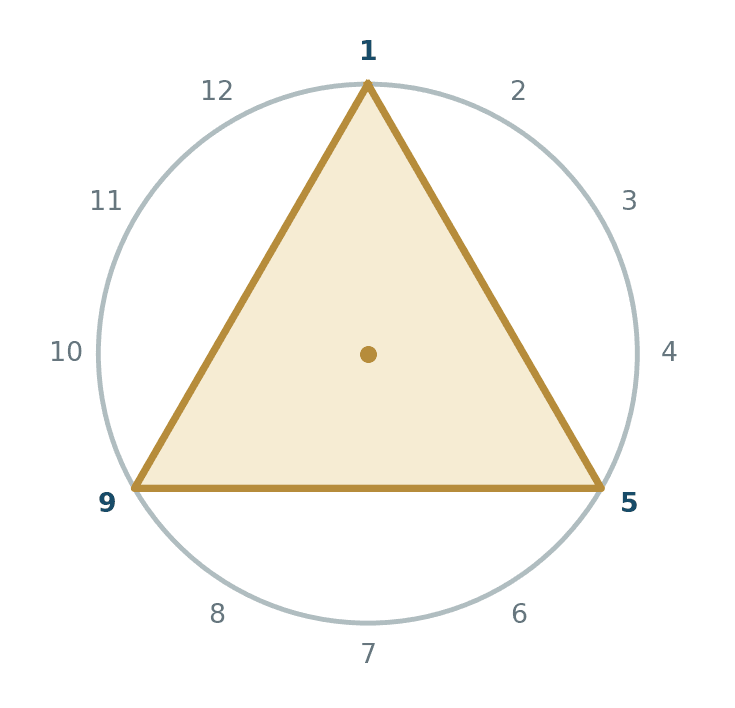
The 1–5–9 relationship: three equally spaced points in the twelvefold zodiac.
“The first breath is 1–5–9. The last breath too.”
We ordinarily approach astrology with a question: What will happen? Yet a deeper inquiry comes first: What principles connect a person, a question, the circumstances that produced it, and the changing conditions through which an outcome may unfold? This research proposes the 1–5–9 trinity as an organizing framework for that investigation—not merely for Prashna, but, in the author’s wider philosophical view, for the processes of life itself.
This article begins with something concrete: how Prashna Siddhi is practised. It then moves outward to the architecture of the twelve Bhavas, planetary relationships, time, obstacles, and the purpose of guidance beyond prediction.
1 Prashna is not simply a substitute for a missing birth chart
Classical Jyotisha gives importance to Janma Kundali, the horoscope of birth. The term Nashta Jataka is associated particularly with attempts to reconstruct a lost or unknown natal horoscope. It must not, however, be taken as the name or definition of the whole Prashna tradition: question-based astrology has a wider field of inquiry.
A birth chart is a fixed reference established at birth, interpreted against an unfolding life. Its planetary periods—Dasa, Bhukti and Antara—provide successive interpretive windows. Relevant transits are then considered to examine whether prevailing conditions support, delay or qualify a potential event. An apparently excellent planetary period alone need not mean that the desired event will occur at once.
“A birth chart is like an ocean; a Prashna investigation is like searching within a pond.”
Searching for an object in a vast public space is unlike searching for it within one’s home. The analogy concerns the scope of investigation, not a claim that one technique is infallible or that the other is inferior. Prashna concentrates attention on a pointed question.
2 The essential distinction: rising Lagna and discrete Aarooda Lagna
A common question-time horoscope may start with the ascendant rising at the time and place of inquiry. Software can calculate that ascendant from astronomical inputs. This is a legitimate reference used in many Prashna approaches; it is not the distinctive starting nucleus of the method described here.
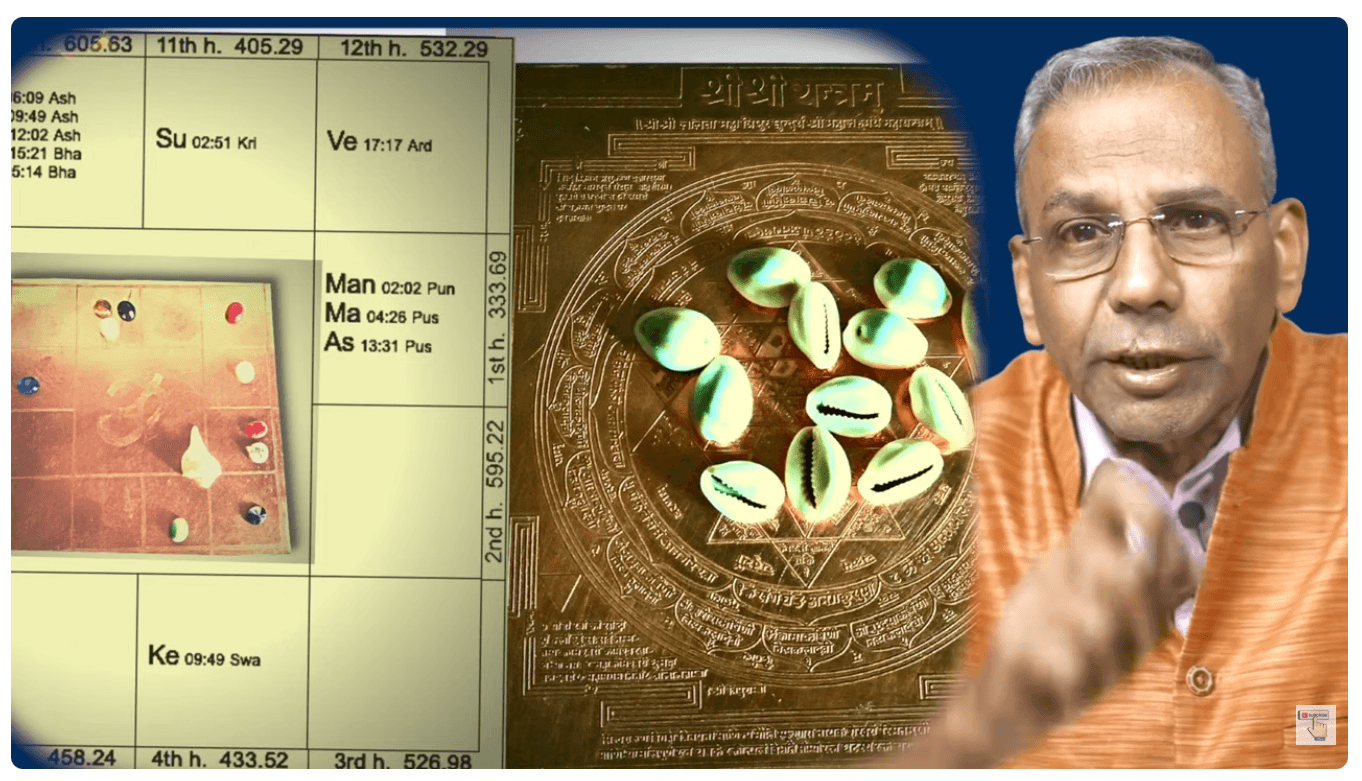
In the author’s practice, for each pointed question from each person, a separate Aarooda Lagna is derived by shuffling twelve cowries at the astrologer’s fixed place of practice. The question may be asked at different times of day or night. The selected Aarooda becomes the question-specific reference from which relevant planetary and Bhava relationships are investigated. A new Aarooda is derived for a new pointed question; it is not assumed to be the same reference for every question.
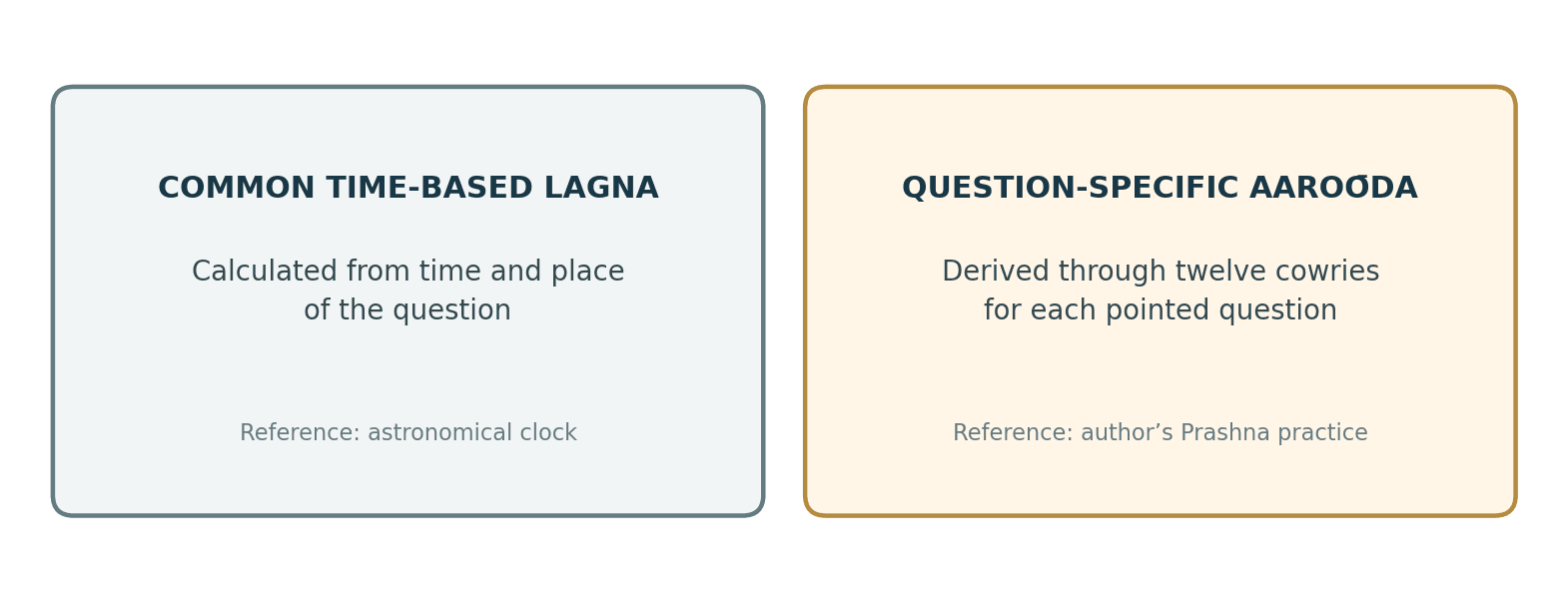
The precise rule by which a particular cowrie arrangement is converted into a sign or Bhava is a separate technical procedure. It is not reproduced here without a verified demonstration. The key distinction for the reader is that the author does not merely rename the rising Lagna as Aarooda.
3 Twelve cowries: an actual working practice
The cowries are part of the author’s practical method, not an ornamental symbol. Their selection is applied separately to the question at hand, and the derived Aarooda Lagna becomes the point of reference for the analysis. This gives the question—not simply the clock—a central place in the consultation.
This distinction has been demonstrated for viewers in the author’s live-stream question-and-answer sessions, not only described in writing. An electronic teaching board displayed the day’s planetary positions and Maandi. Selectable LEDs illuminated the relevant point for each question, allowing viewers to follow the changing Aarooda reference visually.
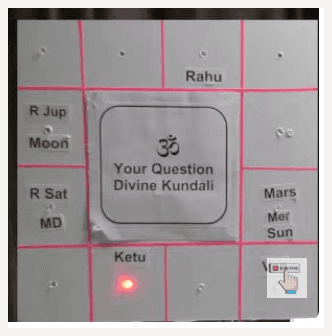
Figure 3. Electronic Aarooda teaching board
Actual board used during live Q&A sessions. The illuminated LED indicates a selectable question reference; the board also shows the day’s planets and “MD” (Maandi). This is a demonstration aid, not an automatically generated prediction.
Such examples help the reader see what the interpretive starting point actually means. The working practice and the explanation remain the author’s; the diagram or board alone cannot establish predictive accuracy.
4 The ascendant lord and Maandi: keys, conditions and the “black box”
After selecting the question-specific Aarooda, the ascendant and its sign lord become central in the author’s analysis. The relevant Bhavas, their lords, strength and associations, special aspects and transits are not read in isolation. They are brought together to ask whether an outcome is supported, opposed, delayed or qualified.
Maandi—treated in this method as closely associated with Saturn—is described by the author as a “black box”: a metaphor for a difficult or limiting influence that deserves special attention before reaching a conclusion. This is an interpretive description of Maandi in his practice, not a statement that Maandi is an astronomical planet or a physical harmonic frequency of Saturn.
A favourable indication may coexist with real hurdles. Understanding those hurdles can be more helpful to the questioner than a simple yes-or-no verdict.
5 What makes the 1–5–9 trinity central?
Number the twelve Bhavas in a circle. From any starting Bhava, count the first, fifth and ninth inclusively. The result is a repeating trinal family: 1–5–9, 2–6–10, 3–7–11 or 4–8–12. In a circle divided into twelve equal sectors, adjacent positions are 30° apart; each step in the 1–5–9 triad covers four sectors, or 120°. Connecting the three points makes an equilateral triangle.
In the proposed Prashna Siddhi framework, the first, fifth and ninth relations are not isolated predictions but an organizing nucleus for examining origins, relevant antecedents, changing circumstances and possible direction. This is the author’s philosophical and astrological interpretation; the geometry alone does not prove an underlying universal cosmic law.
The thesis extends beyond astrology: from the first breath to the last, the author seeks connected processes rather than disconnected episodes. The book in preparation explores possible parallels in sacred geometry, planetary exaltation, Nakshatras, the number 108 and the Karmic Reactor. Those comparisons require their own careful treatment and should not be assumed to establish physical causation.
6 Special aspects and transits: the chart must be read in motion
The author places particular emphasis on the Vishesh Drishti of Mars (4th and 8th), Jupiter (5th and 9th) and Saturn (3rd and 10th), interpreting these additional relationships as enriching or reforming influences within the wider Karmic Reactor model. Planetary positions, lordships, aspects, Maandi where applicable, and transits are examined together.
A birth chart is a fixed reference across a long life: Dasa–Bhukti–Antara may define a promising period, while the relevant transits affect how the period is interpreted. It resembles aiming at a moving object with parameters originally derived from a static table. In Prashna, the question and the interlocutors are already participating in the ongoing situation; the discrete Aarooda provides a focused reference from within that situation.
Technically, both birth and Prashna charts are snapshots at particular times. The distinction is not that one physical chart moves and the other does not. It is the scope and the method by which changing circumstances are investigated.
7 One person, different questions: connecting the dots
One Prashna Kundali may contain information relevant to several concerns of a person. The author nevertheless derives a separate Aarooda Lagna for each pointed question and examines it independently. The individual findings should then be logically compatible, even where they concern different subjects. In the author’s words, each finding is a dot: joining the dots should reveal a straight line—a coherent account of the same person’s circumstances.
Suppose the employment investigation indicates the possibility of a job after approximately two months. Without announcing the second inquiry, a discrete financial Aarooda is derived. If the second Bhava presently indicates strain, the astrologer examines its lord and other significators, planetary associations, special aspects, Maandi and the full pattern of relevant transits over the proposed period. A subsequently favourable second-house lord transit may add weight to the assessment when the broader indications also support it.
This is an illustrative method, not a documented successful prediction about an identifiable individual. Moreover, a job offer, joining date, first salary and financial relief may happen at different times. Independent astrological agreement is an internal corroboration, not proof that the outcome must occur.
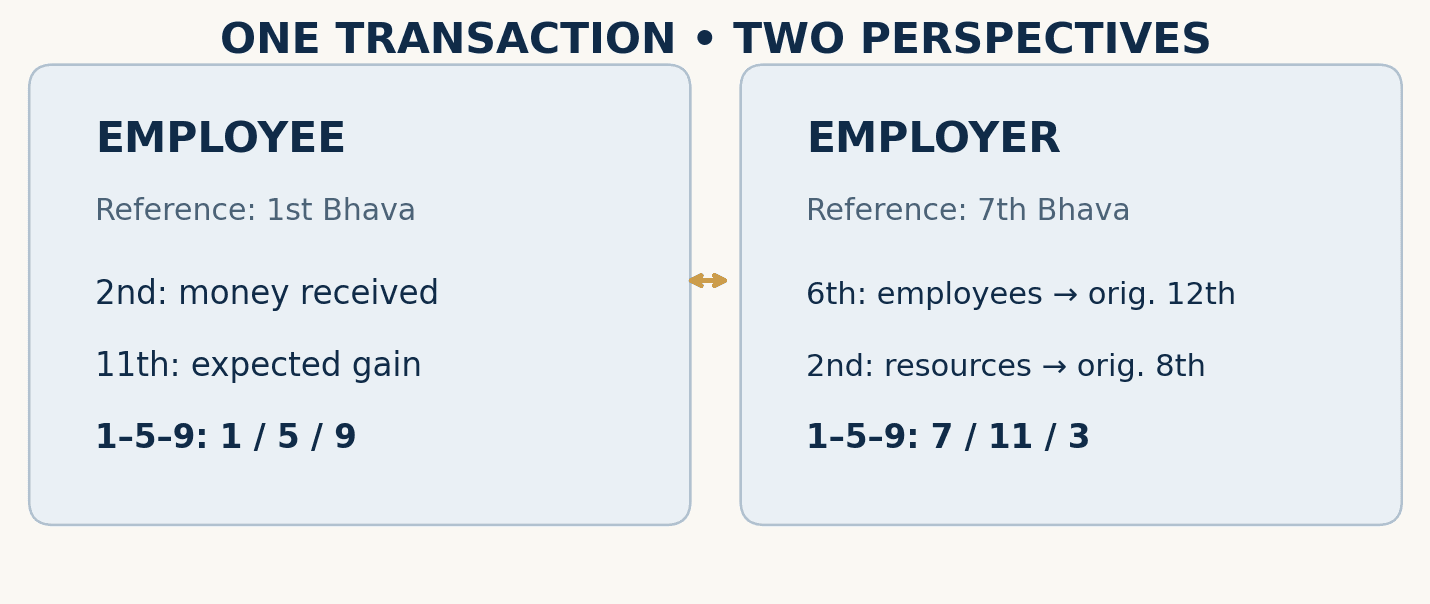
For a salary question, the employee’s receipt and the employer’s obligation are two views of one transaction. From the employer’s standpoint the sixth Bhava is relevant to employees and service; the seventh may still matter as a counterpart in the relationship. Adverse employment conditions need not rule out eventual payment. The same inquiry should reveal hurdles as well as prospects.
8 The questioner, astrologer and moment of contact
A Prashna consultation begins only when a person establishes contact with an astrologer. The author sees that occasion as part of the same unfolding universal process: the questioner, the astrologer, the question, the answer and the satisfaction or disappointment arising from the encounter are all participants. Within his philosophy, the moment may be understood as predestined. That is a spiritual interpretation, not a demonstrable claim about the physical mechanics of the universe.
Likewise, the possibility that an astrologer can be wrong must be taken seriously. Neither devotion nor a beautiful explanation is a substitute for recording what was predicted, when it was predicted, what was expected to happen and what actually happened. Accurate assessment requires examples of failure as well as success. The astrologer is not outside the process being interpreted.
9 Why knowledge matters more than promises
This approach is intended to move beyond prediction as a product. A serious interpretation should illuminate the underlying situation, indicate the possible scope of an outcome, identify obstacles and help the person decide how to respond constructively. The author’s experience is that devotion, sincerity and morally grounded inquiry may make such guidance especially meaningful; it is not a guarantee that a particular person will receive an agreeable answer.
“The goal is not merely to anticipate the fruit, but to understand the roots and the path.”
The purpose of this research is neither to invalidate other traditions nor to claim that all the proposed connections have been scientifically proven. It is to place a coherent interpretation on public record, with sufficient clarity that thoughtful readers can examine, question, test and build upon it.
10 An invitation to readers and researchers
The Universal Architecture of 1–5–9 is presented here as an original Prashna Siddhi research proposition, with Prashna Kundali as one practical application. Its geometric components can be demonstrated exactly; its wider claims about existence, planets, karma and destiny remain interpretive proposals. Readers are invited to examine the reasoning, offer constructive criticisms, and explore well-documented cases—without reducing the work to a contest of spectacular predictions.
A comprehensive illustrated e-book is being developed to expand the roles of planetary exaltation, Nakshatra, special aspects, transits, Aarooda Lagna, Maandi, cross-question corroboration and the Karmic Reactor.
Watch the practical demonstration
Existing Prashna Siddhi channel video demonstrating cowrie casting, Aarooda determination, and the live Prashna methodology:
Source channel video: https://youtu.be/DuM_YzOqCD8
