Uranium Enrichment and Conscience Enrichment
Power, Geometry, Biology, and the Moral Responsibility of Civilization
There comes a point in the life of civilization when intelligence itself stands before a mirror. Humanity has reached such a point.
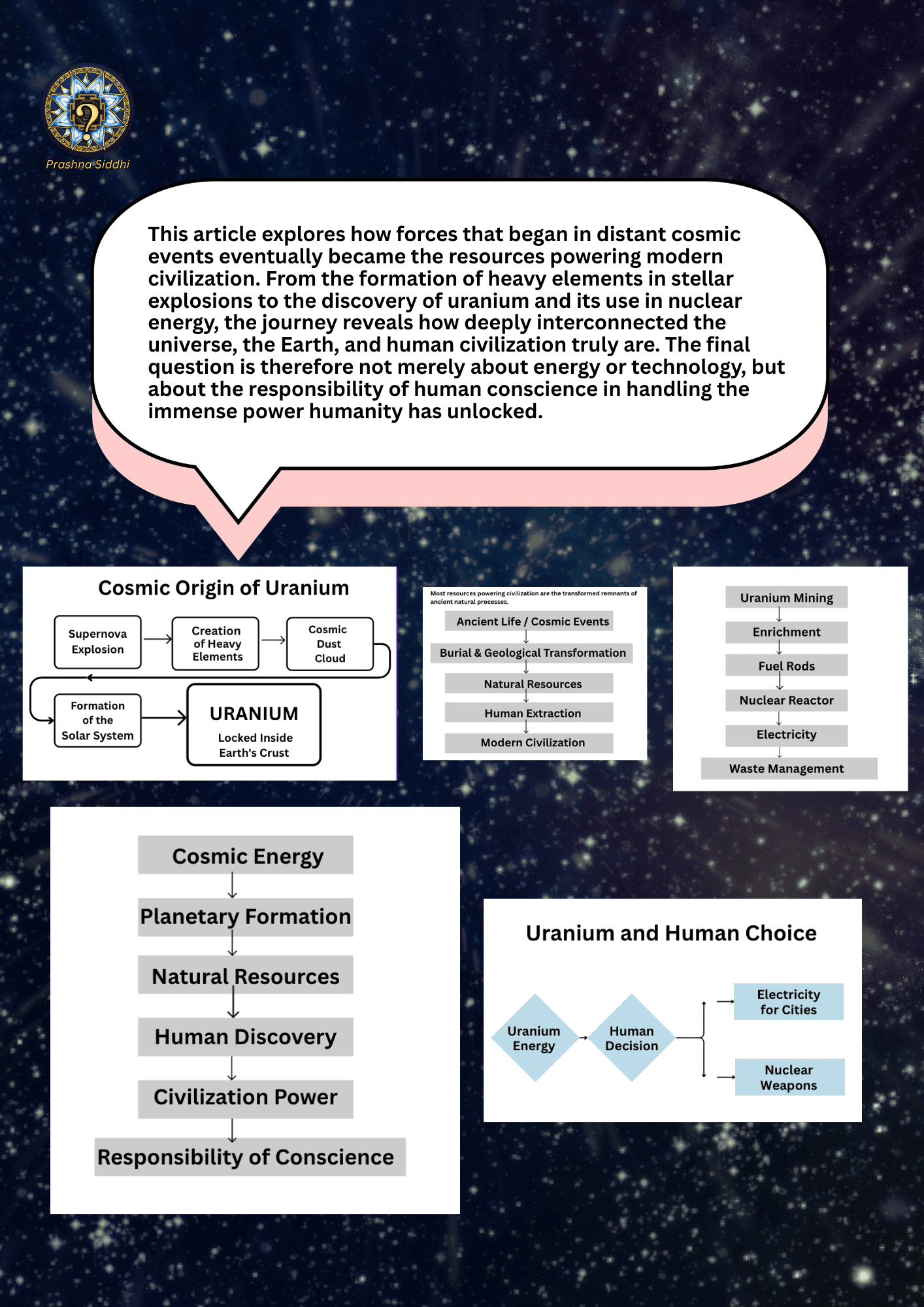
We have learned how to split the atom. We have learned how to enrich uranium. We have learned how to concentrate hidden energy inside matter and convert that concentrated energy into force of astonishing scale. We can light cities, power hospitals, and push the frontiers of science. We can also, with the same knowledge, threaten entire populations and reduce generations of labour, culture, memory, and hope into smoke.
This is not merely a scientific issue. It is not merely a political issue. It is not merely a military issue. It is a civilizational issue. It is a moral issue. And beneath that, it is a question of consciousness.
The real problem before humanity is not whether uranium can be enriched. Humanity has already solved that problem. The real problem is whether conscience can be enriched. The real problem is whether the human being, after mastering physical energy, can also master ethical energy. The real problem is whether power will remain imprisoned inside fear, rivalry, and domination, or whether it will be guided by welfare, restraint, and wisdom.
This article takes a route that is rarely attempted in public discussion. It does not isolate science from astrology, or biology from geometry, or spirituality from material processes. It proceeds from a simple premise:
"The Creator has not made separate universes for science, astrology, technology, biology, philosophy, and spirituality. Humanity has made those compartments. Nature has not."
The same universe is being observed through different lenses:
- •A physicist approaches it through equations.
- •A biologist approaches it through cells and genes.
- •An engineer approaches it through systems and utility.
- •An astrologer approaches it through timing, cycles, and celestial correspondence.
- •A philosopher approaches it through meaning and principle.
- •A seeker approaches it through inward awareness.
The lens changes. The universe does not. The subject of uranium enrichment, therefore, cannot be confined to the laboratory alone. It must be placed inside a wider frame: power, order, geometry, biological precision, cosmic timing, human sensory architecture, and the ethical destiny of civilization.
That is the attempt here.
1. The Nuclear Question Is Not Technical Alone
When people hear the words uranium enrichment, they usually think of geopolitics, sanctions, reactors, bombs, deterrence, or strategic rivalry between nations. All of that is real. But that is not the deepest layer of the issue.
The deepest layer is this: uranium enrichment is one of the clearest examples in the modern world of what happens when latent power is concentrated.
Natural uranium contains power, but not in the concentrated form required for many nuclear applications. Through enrichment, a specific potential within matter is increased. The energy was always there. Human effort did not create the energy. Human intelligence found a way to isolate, intensify, and direct it.
That point is crucial.
Human beings often speak as though they create reality. In truth, they discover methods of working with realities that already exist.
No scientist created the atom. No engineer created electricity. No mathematician created number. No astrologer created the zodiac. No philosopher created truth.
Humanity discovers, names, organizes, interprets, and applies what already exists. The underlying order is prior to us.
If this much is understood, the debate immediately rises to a higher level. The question is no longer merely: What can be done with enriched uranium? The question becomes: Why is civilization so eager to enrich physical power while neglecting the enrichment of moral power?
Why does humanity spend extraordinary intelligence, resources, secrecy, urgency, and national prestige on refining matter for force, while leaving the refinement of conscience to neglect, convenience, or ceremonial speech?
This is not a rhetorical ornament. It is the central indictment of the modern age.
📥 Download the FREE Uranium & Conscience E-Booklet
Available now at PrashnaSiddhi.com/books
No email capture. Direct access only.
2. The Race of Nations and the Poverty of Conscience
Let us speak plainly.
The world spends staggering energy on preparing for destruction.
- Not merely on defence.
- Not merely on strategic caution.
- On destruction.
If the same intensity, funding, creativity, discipline, speed, and engineering genius directed toward advanced weapons systems were directed toward public health, food security, clean energy, civil infrastructure, education, and the inner refinement of human beings, the face of the Earth would already be different.
What exactly is civilization proving when it becomes more efficient at threatening life than at dignifying it?
What do the high and mighty of the Earth imagine they are securing when they build stockpiles of fear and call it peace?
What kind of intelligence races to refine uranium for supremacy but moves slowly, hesitantly, and selectively when the subject is hunger, disease, ecological decline, mental instability, and social fragmentation?
This contradiction is not accidental. It reveals the imbalance of the age.
Science has advanced. Conscience has not kept pace.
That is the real crisis.
Nuclear technology itself is not the villain. The atom is not immoral. Matter is not guilty. Knowledge is not the enemy. The danger begins when human will, un-purified and undisciplined, harnesses extraordinary force without a corresponding expansion of wisdom.
A civilization that enriches uranium without enriching conscience has magnified its danger.
A civilization that enriches both can become a blessing.
That is the fork before humanity.
3. Concentration Is the Secret of Power
There is a universal law visible across many domains: concentration produces power.
In uranium enrichment, concentration increases usable atomic potential. In optics, concentration of light creates laser precision. In electricity, voltage and current are controlled expressions of concentrated energetic behaviour. In agriculture, concentration of nutrients affects growth. In intellectual life, concentrated thought produces insight. In spiritual life, concentrated awareness produces clarity.
Scattered force is weak. Concentrated force transforms.
This is why uranium enrichment is such a powerful symbol — not merely a technical process. It illustrates a universal principle: what is latent becomes effective when concentrated, refined, and directed.
The reason this matters philosophically is that the same principle applies to the human being.
A distracted mind is weak even when it is educated. An undisciplined conscience is dangerous even when it is intelligent. A scattered civilization is noisy but shallow. A concentrated conscience becomes a source of stability, discernment, and peace.
This is why the phrase conscience enrichment is not decorative language. It is a civilizational necessity.
3A. Criticality: A Scientific Word with Philosophical Meaning
In nuclear engineering there is a term that deserves closer attention: criticality.
When scientists say that a reactor has reached a critical state, they do not mean danger in the dramatic sense. They mean that the nuclear chain reaction has reached a stable, self-sustaining level. Each fission event produces enough neutrons to sustain the next event without collapse or runaway explosion.
In other words, the system has reached equilibrium in concentrated power.
This concept offers an interesting philosophical parallel.
In spiritual practice, many traditions speak of concentrating awareness inward. When the scattered movements of thought, impulse, and sensory distraction are gradually gathered into focused attention, consciousness itself enters a more stable state.
The body remains normal. The external world continues to exist. Yet the centre of awareness shifts from outward dispersion to inward clarity.
One may say that consciousness has reached its own form of criticality — a sustained state of awareness rather than scattered mental reaction.
This should not be taken as literal scientific equivalence between physics and spirituality. The processes belong to different domains. But the underlying principle is recognizable:
Concentration transforms potential into power.
Whether the subject is nuclear energy or human awareness, scattered forces remain weak while concentrated forces become decisive.
4. Did Humanity Invent These Patterns, or Discover Them?
If we move beyond nuclear science for a moment and look at everyday technological life, we notice something interesting. Electrical systems often organize around numerical structures that repeatedly involve twelve and its multiples: 12-volt systems, 24-volt systems, 120 or 240 domestic electricity, 440 industrial systems. The details differ across engineering contexts and historical standards, but the larger point remains striking: humans frequently adopt number-patterns that are divisible, scalable, balanced, and structurally useful.
Why? Because the universe is not mathematically anarchic. It yields to pattern. It rewards proportion. It operates through repeatable order.
Now observe something else: astrology too is structured through twelve. The zodiac is divided into twelve signs. Time is spoken through cyclical division. The day is divided. The year is divided. The sky is read through organized segments, not chaos.
So we must ask a deeper question: Did humans arbitrarily impose twelves upon reality? Or did they discover that certain forms of order repeatedly work because they reflect something already embedded in creation?
The honest answer is obvious: humanity adopts what reality allows and rewards.
We do not legislate cosmic order into existence. We slowly notice it.
That is why the separation between science and astrology is often overstated. Their methods differ sharply, yes. Their assumptions differ, yes. Their uses differ, yes. But both arise from the recognition that the universe is patterned.
One calculates. One interprets. But neither can function if reality is wholly random.
4A. Universality of Knowledge and the Illusion of Separation
At this point a larger observation becomes unavoidable. The modern world often behaves as though knowledge itself were divided into separate territories. Physics is placed in one department, biology in another, engineering in another, philosophy somewhere else, and spirituality or astrology often pushed to the margins.
Yet the universe itself has not built such compartments.
Matter does not consult a department before forming an atom. Biology does not consult a faculty before organizing DNA. Geometry does not wait for a mathematician before structuring stability. The same laws, patterns, and relationships operate across scale.
Human specialization is useful. It allows deeper study within a field. But specialization can also create a subtle illusion — that knowledge itself is fragmented.
In truth, the divisions exist mainly in the organization of universities, professions, and intellectual traditions.
Nature itself remains unified.
The same universe that physicists examine through equations is the universe in which biologists study cellular organization, engineers design machines, and astrologers observe cycles and correspondences.
The instruments differ. The language differs. The questions differ.
But the universe being examined is one.
When this unity is forgotten, knowledge becomes fragmented. When it is remembered, different disciplines begin to illuminate each other.
5. Polarity: Aries, Taurus, Day and Night, Positive and Negative
In astrology, Aries is described as positive, Taurus as negative, and so on in alternating sequence. Many people repeat this as textbook language without pausing to examine what it reveals.
The alternation itself matters.
Nature works through polarity.
Day and night. Positive and negative charge. Expansion and contraction. Action and consolidation. Emission and reception.
Polarity is not hostility. It is order.
This distinction matters because civilizations often misunderstand complementarity as conflict. Similarly, many astrologers repeat phrases such as "Sun and Saturn are enemies," as though the cosmos were a petty court of rival egos. Such language may have symbolic use in narrow interpretive contexts, but when repeated without depth it shrinks the grandeur of the universe into human drama.
The universe is not built on gossip. It is built on law.
If Saturn signifies time, discipline, pressure, endurance, delay, or structure, then Saturn is not an enemy. It is part of the architecture of reality. Without structure there is no form. Without time there is no process. Without pressure there is no condensation. Without delay there is no maturation.
Likewise, the Sun cannot be reduced to mere royalty or egoic brilliance. It is centrality, illumination, energy, source, and order.
To call such principles "enemies" without philosophical depth is to reduce cosmic function to the language of household dispute.
The higher understanding is this: different principles interact, constrain, complement, and condition each other within a whole. That whole is prior to our emotional labels.
This is the kind of holistic correction that astrology urgently needs.
6. The Secret of the Trines: 1, 5, and 9
Among the most overlooked geometries in astrology is the trinal relationship of 1, 5, and 9.
Why should these positions be special? Why should they repeatedly indicate support, flow, resonance, or deeper continuity? Why should a triangle inside a circle carry such structural importance?
Because geometry itself is speaking.
Connect 1, 5, and 9 on the zodiacal circle and you form an equilateral triangular relation. In geometry, the triangle is the simplest stable figure. A square can distort into a rhombus unless reinforced. A circle has unity but not directional structure. A triangle locks relation.
This is not merely symbolic ornament. It suggests that certain relationships are inherently stabilizing.
Now carry this insight further.
The triangle within the circle appears in multiple civilizational languages. In Hindu sacred geometry, triangular forms within circular containment recur powerfully. The Srichakra tradition, though interpreted through devotional and metaphysical frameworks, reminds us that geometry can be both spiritual and structural. The triangle is not accidental. The circle is not accidental. The relationship between them is not accidental.
When astrologers speak of the trines without ever asking why the trines should matter, they use inherited conclusions without plumbing inherited intelligence.
This article insists on restoring the question.
The geometry of the trines must be thought about, not merely memorized.
Related explorations in the Prashna Siddhi Knowledge Section:
6A. The Structural Echo of Three
The significance of the trines — 1, 5, and 9 — also invites a broader reflection on how structural patterns repeat across different domains of knowledge.
In astrology these positions form a triangular relationship within the zodiacal circle, and they are traditionally associated with flow, continuity, and support.
Geometry explains why: the triangle is the simplest stable form.
Interestingly, biological development also unfolds in recognizable stages. Human gestation is commonly described in three major phases — three trimesters — each marking a distinct stage in the emergence of life.
During the early weeks of embryonic development, especially between the third and eighth week, the embryo undergoes rapid and precise formation of organs, limbs, and neural structures. Biology calls this organogenesis.
The point here is not to force mystical equivalence between biology and astrology. It is simply to notice that structured progression appears repeatedly in nature.
Certain patterns — such as threefold stages or triangular stability — recur because they are structurally efficient ways for complex systems to organize themselves.
Ancient observers noticed such patterns and encoded them symbolically in various traditions. Modern science observes them through empirical investigation.
Different languages. Different methods. The same creation.
7. Circle, Triangle, and the Language of Creation
The circle suggests wholeness, continuity, return, completeness, source without corners.
The triangle suggests emergence, structural relation, directional stability, a minimal architecture of form.
When triangle and circle interact, one can read a deep philosophical statement:
The One becomes structured without ceasing to be One.
This statement belongs as much to metaphysics as to geometry.
Creation is not separate from source. It is source in expression. Diversity does not cancel unity; it articulates it.
This is why the slogan "source back to source" is not poetry alone. It describes a law of transformation.
Stars form, burn, collapse, recycle matter. Life emerges, evolves, dies, transforms. Energy changes form. Matter changes arrangement. Consciousness passes through states of contraction and expansion.
The origin and the end are not strangers.
The universe is procession and return.
This same principle makes the uranium question even more serious. If energy is part of a sacred order of transformation, then to weaponize it without conscience is not only dangerous — it is spiritually immature.
8. The Biological Exactness of Human Formation
Let us now move into biology, because the human being must not be discussed only as a consumer of technology but also as an expression of cosmic order.
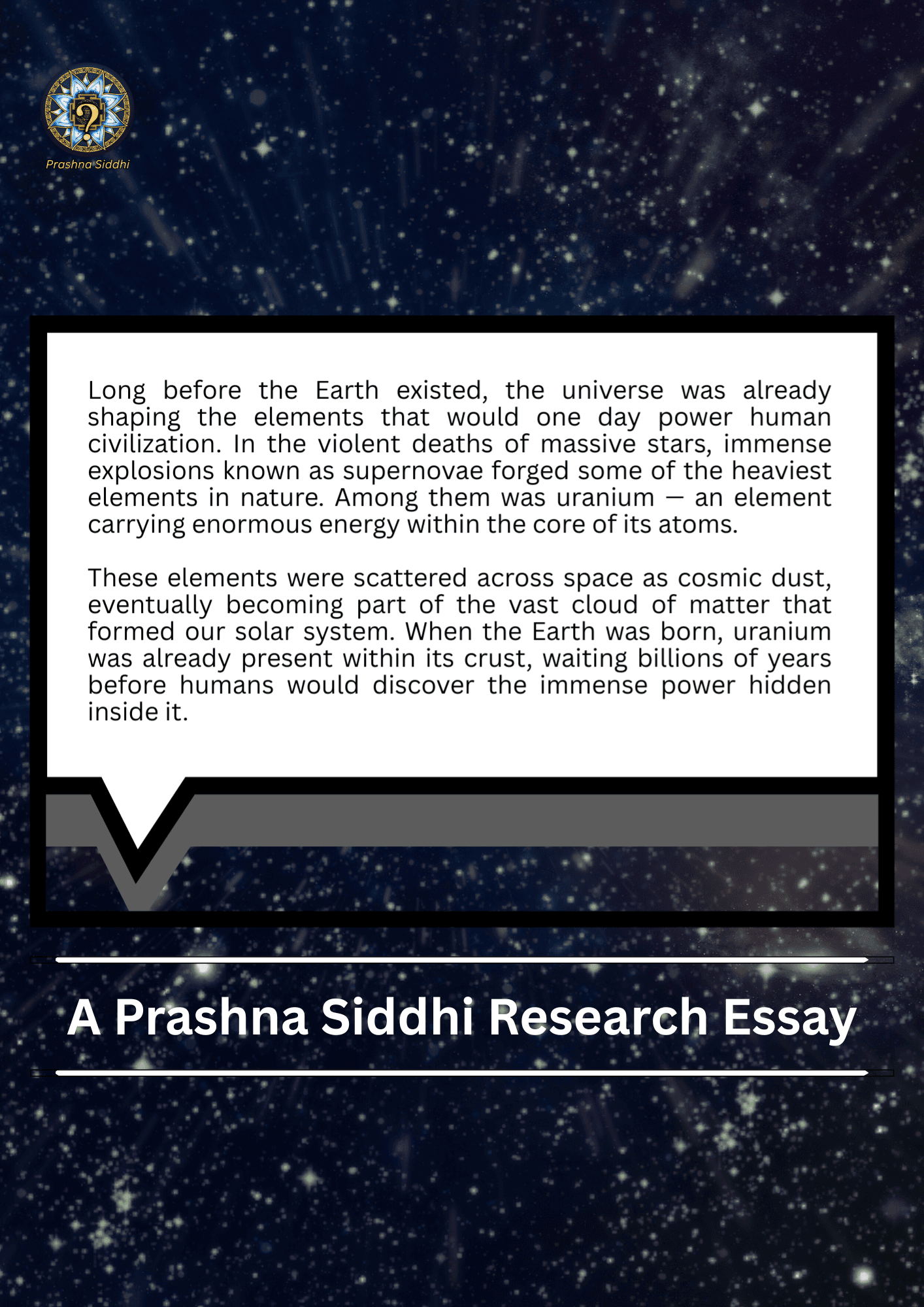
Each parent contributes 23 chromosomes. Together they form 46. This fact is routinely taught in biology, yet very few pause over its philosophical significance.
Life begins not in conceptual chaos but in precise coded order.
What emerges from this union is not merely tissue. It is a developing architecture.
DNA replication, cellular differentiation, embryonic patterning, organ formation, neural development, sensory emergence — these are not random accidents piled together. They are process, sequence, timing, relationship.
Biology is not noise. It is disciplined unfolding.
This does not mean every biological fact should be converted into mystical code. It means only that life itself testifies to structured intelligence in process.
The embryo is not assembled by guesswork. Cells do not negotiate their way into organs through confusion. Sequence matters. Timing matters. Order matters.
And if order matters in embryology, why should order be dismissed in cosmic cycles? Why should it be shocking that the same creation may display layered correspondences across scale?
Again, the methods of biology and astrology are not identical. But the philosophical observation remains valid: the universe is not careless in its architecture.
9. 23 + 23 = 46, and the Return to Unity
It is important to draw attention not only to chromosomes themselves, but also to the reflective power of number.
Twenty-three plus twenty-three makes forty-six. Successive reduction yields one. In nuclear engineering there is a term that deserves closer attention: criticality.
Without making crude numerological claims, one may still observe something philosophically suggestive here: multiplicity resolves into unity.
Two parental streams. One organism. Countless cells. One body. Many sensory inputs. One field of consciousness. Diverse disciplines. One universe.
Here again the structural thought is more important than a mechanical number game. The universe repeatedly shows that many become one, and the one expresses as many.
This is exactly the kind of insight that should be stated carefully yet firmly in a holistic article: unity is not the enemy of diversity. Diversity is often the expression of hidden unity.
10. Panchendriyas and the Fivefold Interface of Human Life
Indian philosophical thought speaks of the Panchendriyas — the five sensory capacities through which human beings interact with the outer world:
Sight. Hearing. Smell. Taste. Touch.
These are not merely biological functions. They are the interfaces of embodied experience.
The human being is not a loose collection of parts. It is an integrated design.
But this design has a problem: the senses pull awareness outward.
Civilization intensifies this outward pull. Noise, appetite, ambition, distraction, stimulation, fear, image, reaction — everything conspires to scatter attention across surfaces.
That is why conscience enrichment cannot happen without some degree of sensory discipline.
The senses are not enemies. They are gateways. But gateways require governance, just as a reactor requires control rods if power is to remain constructive rather than destructive.
11. Nine Openings and the Tenth Door
Traditional thought speaks of the body as having nine openings toward the external world:
Two eyes. Two ears. Two nostrils. The mouth. Two lower apertures.
Nine outward channels.
And then there is the symbolic tenth door — not another physical aperture in the ordinary sense, but the principle of inward ascent, the opening of higher awareness, the disciplined redirection of mind toward the seat of deeper consciousness, often associated with the third eye.
Whether one chooses to speak in explicitly spiritual language or more restrained philosophical language, the core insight remains:
Human life is normally dispersed outward. Mastery begins when awareness learns inward concentration.
This is the point at which the uranium analogy becomes powerful.
Uranium enrichment concentrates atomic potential. Conscience enrichment concentrates ethical and spiritual potential.
One without the other leads to imbalance.
12. The Uranium Parallel: Physical Enrichment and Metaphysical Enrichment
"Conscience enrichment is nothing short of uranium enrichment. One is physical. The other is metaphysical. The effects are opposite. One can culminate in destruction; the other in welfare, peace, and tranquillity."
Physical Enrichment
Enriched uranium can produce immense outward force.
The first can reorganize matter.
The first may light cities or destroy them.
More physical power?
Metaphysical Enrichment
Enriched conscience can produce immense inward stability.
The second can reorganize civilization.
The second may restrain destruction and direct intelligence toward welfare.
Or more purified conscience in those who command power?
The answer is obvious.
13. The Creator Did Not Fence Knowledge Into Departments
This article now returns to its foundational claim.
The Creator did not make a separate universe for physicists and another for astrologers. There is not one creation for biologists, another for engineers, another for philosophers, and another for spiritual seekers.
Creation is one. Human disciplines are many.
That means all true knowledge is, at root, the property of the same ultimate source. The differences lie in angle, method, language, scale, and purpose.
Science asks: How does this function? Philosophy asks: What does this mean? Astrology asks: How does this correspond in timing and cycle? Spirituality asks: What is the inner law and ultimate direction of life?
If each remains imprisoned within its departmental ego, the world gets fragments.
If they begin to converse without confusion, humanity gets vision.
This is the research highway being pointed to here.
Not a demolition of disciplines. A widening of perspective.
14. Lagna: The Living Point of Emergence
Even though this article centres on uranium, one principle from astrology must be stated plainly.
The Lagna, or Ascendant, is not merely a technical marker for horoscope interpretation. It is the sign of emergence. At every instant a point rises in the East. There is no stoppage in this process. No final freeze-frame. The Earth rotates. The horizon renews. A new point rises ceaselessly.
In that sense, Lagna is a living principle.
It is not the property of human beings alone. It reflects a cosmic geometry of emergence. Human astrology uses it in one way, but the principle itself belongs to the universe.
This is why the living moment matters. This is why Prashna Lagna matters. This is why the exact instant is not superstition but structural seriousness.
At every instant, emergence is occurring.
And because emergence never stops, existence itself is closer to process than to fixed identity.
This makes the older obsession with reducing everything to Moon sign in one part of the world and Sun sign in another look superficial. Those may have pedagogical or popular uses, but the living moment is where life is actually unfolding.
15. Special Aspects, Hidden Roots, and the Need for Deeper Astrology
Certain astrological doctrines are repeated for centuries without deeper examination. Trines are memorized; aspects are applied; special aspects are taught; but where is the serious inquiry into their geometric, symbolic, or philosophical root?
You can follow these links for detailed understanding:
This question must be brought into the article not as hostility, but as challenge.
A living tradition must think. It must not merely recite.
If astrology wishes to stand with dignity before serious minds, it must do more than recycle phrases. It must ask why certain structures recur. It must explain its geometry, not merely inherit it. It must deepen rather than dramatize.
The future of astrology does not lie in louder claims. It lies in stronger foundations.
And one of those foundations is precisely the willingness to see astrology not as a closed trade, but as one lens within a wider universe of patterned knowledge.
This is why readers — especially astrologers — should ask for themselves:
Why were certain philosophical implications not emphasized by later teachers? Was something assumed? Was something lost? Was something left unexplored because specialization replaced wholeness?
Such questions are not disrespectful. They are signs of a living mind.
Blind following weakens a tradition. Thought strengthens it.
16. The High and Mighty Must Hear This
The time has come to say something directly to power.
To the governments, strategists, defence establishments, industrial planners, technocrats, and intellectual elites of the world:
You may master uranium and still remain inwardly primitive.
You may command reactors, missiles, grids, laboratories, and encrypted command systems and still fail the basic test of civilization if conscience does not grow in proportion to capability.
Do not speak of peace while investing disproportionately in the machinery of annihilation. Do not speak of security while nourishing a culture of mutual threat. Do not speak of progress while subordinating welfare to prestige. Do not glorify intelligence when it is severed from wisdom.
The world does not need weaker science. It needs deeper humanity.
It does not need the abandonment of research. It needs the sanctification of purpose.
The age of atomic power demands the age of moral power.
Anything less is instability disguised as sophistication.
17. The Human Being as Symbolically Enriched Uranium
Now the bold statement may be made.
Every human being is, symbolically speaking, like an enriched uranium atom — possessing immense latent power. Not merely muscular power, not merely intellectual power, but the power to think, choose, restrain, create, destroy, heal, uplift, or corrupt.
What determines the direction of that power?
Conscience.
A human being without conscience is dangerous regardless of education. A human being with enriched conscience becomes a source of order.
This is why the true battlefield of civilization is not only territorial, military, or economic. It is interior.
The enrichment of matter without the enrichment of conscience produces crisis.
The enrichment of conscience can redirect matter, science, technology, and power toward human flourishing.
That is the real revolution required.
18. Source Back to Source
The final principle is simple and vast.
Everything emerges from source and returns to source.
Matter transforms. Energy transforms. Civilizations rise and fall. Bodies form and dissolve. Stars ignite and fade. Ideas arise, spread, decline, and return in new form.
Source back to source.
This is why fragmentation is ultimately provisional. Science, astrology, geometry, biology, technology, and spirituality are not enemies in their pure form. They are modes of approach to a single reality.
The disease begins when method forgets source. The healing begins when knowledge remembers source.
Uranium reminds us that power is hidden in matter. Conscience reminds us that destiny is hidden in awareness.
To master one without the other is to remain incomplete.
Conclusion: The Future Depends on What We Enrich
Humanity has already shown that it can enrich uranium. The more urgent question is whether humanity will now enrich conscience.
If it does not, scientific progress may become a magnificently engineered danger. If it does, the same intelligence now spent on fear and rivalry can be redirected toward welfare, healing, dignity, and peace.
Prashna Siddhi Signature
Seen from the deeper perspective of cosmic symbolism, even the zodiac offers a quiet reminder of this journey. The cycle begins in Aries, the spark of emergence and individuality. As the sequence unfolds, it arrives at Cancer, governed by the Moon — the domain of the mind, emotion, memory, and psychological tides that shape human experience. Much of human life remains confined within this lunar field of reactions, desires, and anxieties. But the zodiac does not stop there. The very next sign is Leo, ruled by the Sun. When consciousness moves beyond the restless fluctuations of the Moon — beyond the mind itself — the inner Sun begins to shine. In that moment the Atman reveals its light.
Civilization today stands at a similar threshold. Humanity has unlocked the power of uranium, a force born in the deaths of ancient stars. Yet the real question is whether human awareness will remain trapped within the mind or rise into the clarity of the inner Sun. Power alone cannot guide civilization. Only when the mind is transcended does the light of the Self begin to illuminate the path forward. That is when the Atman truly shines.
"When the mind settles, the Sun within begins to shine — and that light alone can guide power."
The Future of Civilization
Humanity has learned how to unlock the power hidden inside matter. The next task is far greater.
Humanity must learn how to unlock the power hidden inside conscience.
Uranium enrichment reveals the energy of atoms.
Conscience enrichment reveals the direction of civilization.
Power without conscience becomes destruction.
Power guided by conscience becomes welfare.
The future will not be decided only in laboratories, reactors, or political chambers. It will be decided in the quiet space where human intelligence meets responsibility.
When knowledge and conscience grow together, civilization advances safely.
When power grows faster than conscience, danger grows with it.
The choice remains with humanity.
Prashna Siddhi
Knowledge · Awareness · Responsibility
Prashna Siddhi explores the intersection of cosmic order, human consciousness, and civilizational responsibility.
www.prashnasiddhi.com