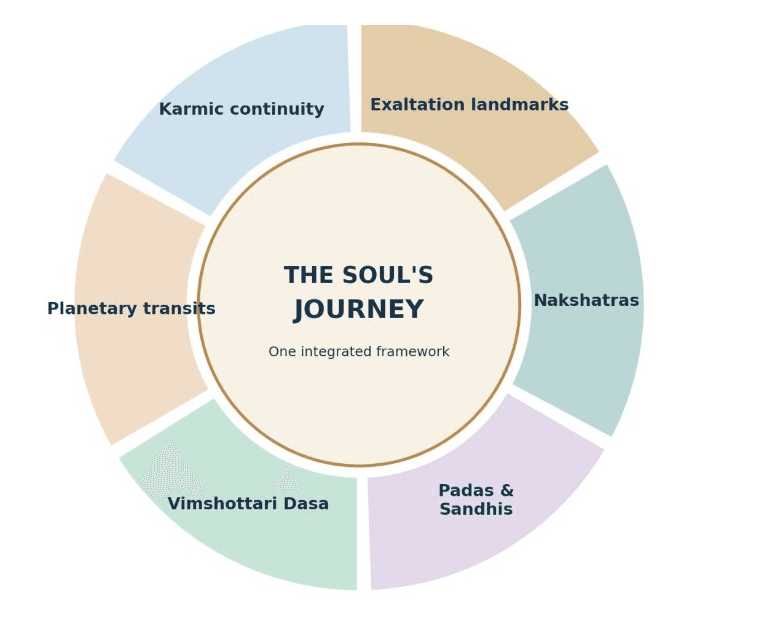
The Soul’s Journey: Six complementary dimensions in one integrated framework.
Research Authorship & AI Transparency
Original spiritual and philosophical framework: K Jagadish, Prashna Siddhi. AI was used for arithmetic calculations, numerical checking, geometric exploration, graphical presentation, source discovery and editorial organization, under the author’s direction. The interpretations, decisions and responsibility for publication belong to K Jagadish.
1. Why revisit an ancient system?
Vimshottari Dasa has been used in Jyotisha for centuries. The familiar explanation lists nine planetary periods, their duration, and the events a practitioner expects during each. That is useful for learning the mechanics, but it is not the question pursued here.
Our question is more basic: what does the timing system mean when the nine Grahas are considered together? Why should Vimshottari Dasa be studied separately from exaltation, Nakshatras, Padas, Pada Sandhis and planetary transits, when Prashna Siddhi proposes that they complement one another?
Prashna Siddhi proposes that Vimshottari Dasa is a map of the Soul’s journey through earthly life, read against a spiritual clock and the changing calendar of transits. The clock is a proposed interpretive metaphor, not a scientifically established measure of the Soul.
A person can study the timetable of a journey without understanding its purpose. Likewise, knowing a Mahadasa’s dates is not the same as understanding the entire planetary context in which that period operates.
💡 Related research: See Why Planetary Exaltation Was Never About Prediction for the foundational inquiry into the moral and spiritual purpose of astrological symbols.
2. Life is a package deal
It is misleading to treat the Grahas as independent departments, rewarding or punishing a person in turns. In this integrated reading, no Graha can be understood in isolation. The opening of a particular Dasa does not switch the other planetary functions off.
A statement such as “Venus is good for you; Saturn is bad” is too crude to stand as a complete interpretation. Classical Jyotisha itself asks the practitioner to consider house lordship, placement, dignity, aspects, relationships and the running subperiods. Prashna Siddhi emphasizes the wider unity of these factors through the Karmic Reactor framework.
The reader’s question should therefore change from “Is this Dasa good or bad?” to “What is the full configuration, and what does it ask of me?”
💡 Related research: Explore how complementary functions operate together in Why Planets Have Special Aspects in Vedic Astrology.
3. The spiritual clock and the birth point
A full Vimshottari rotation contains 120 years, distributed unequally among nine Grahas. A person does not normally begin at the first year of a fixed universal sequence. The opening Mahadasa and its balance are determined by the Moon’s position within its birth Nakshatra.
The clock therefore has a conventional complete cycle, but every individual enters it at a particular point. This is a helpful analogy for the continuity of life: the personal calendar begins at birth, while the larger system is already arranged.
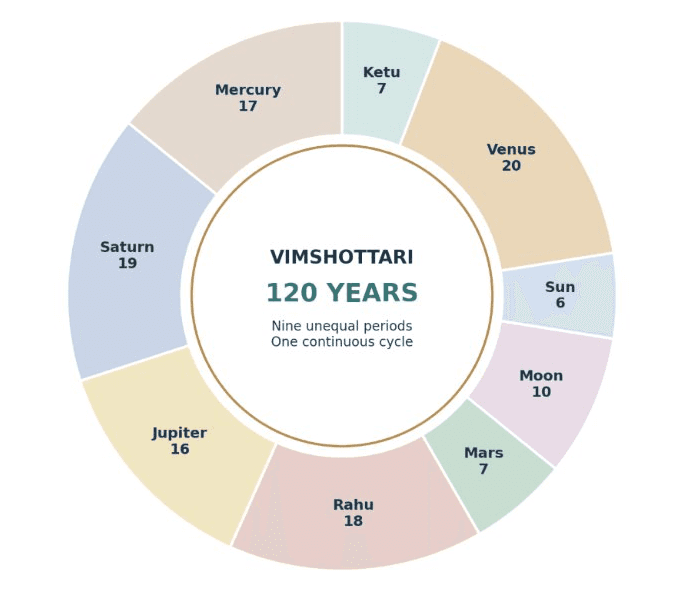
| Graha | Years | Graha | Years | Graha | Years |
|---|---|---|---|---|---|
| Ketu | 7 | Venus | 20 | Sun | 6 |
| Moon | 10 | Mars | 7 | Rahu | 18 |
| Jupiter | 16 | Saturn | 19 | Mercury | 17 |
| Total Traditional Dasa Duration: 120 Years | |||||
The 120-year length is a conventional complete rotation of the Dasa system, not a prediction that an individual must live for 120 years.
💡 Related research: See Child Birth — A Spiritual and Astrological Mystery Unveiled for the discussion of birth as the starting condition for an individual timeline.
4. Nakshatra, Pada and the importance of Sandhi
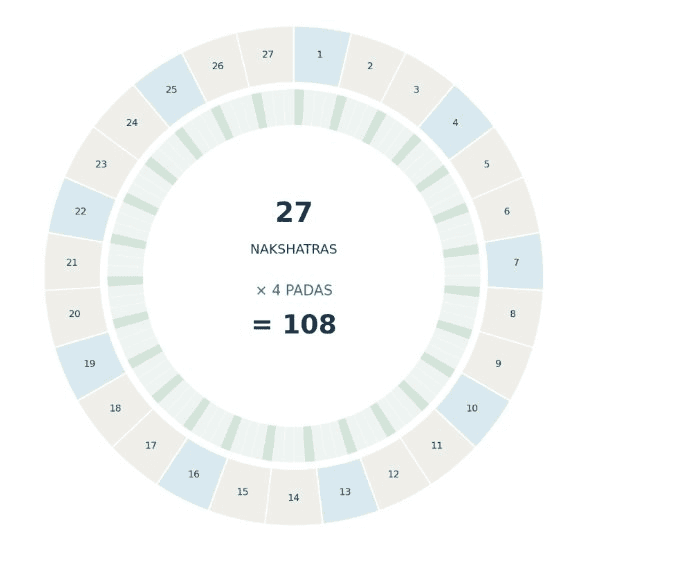
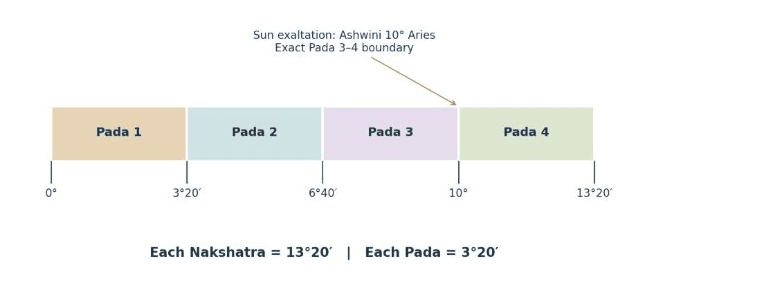
The 360° zodiac is divided into 27 Nakshatras of 13°20′ each. Every Nakshatra contains four Padas, each 3°20′ wide. Thus 27 × 4 = 108 Padas. Every boundary is geometrically definite, including the junction between neighbouring Padas and the junction between Nakshatras.
Prashna Siddhi treats the Pada Sandhi as a meaningful transition worthy of interpretation rather than merely an incidental demarcation. Exact boundaries and nearby positions must nevertheless be distinguished: a point 20 arcminutes before a junction is not itself at that junction. For consistency, this publication assigns a position exactly on a boundary to the subdivision beginning there, while also naming both sides of the junction.
5. The Sun and Moon: two lighthouses
The traditional deep-exaltation point of the Sun is 10° Aries, at the Ashwini Pada 3–4 Sandhi. Under the stated boundary convention, the point begins Ashwini Pada 4 (Cancer Navamsa); just before the junction is Pada 3 (Gemini Navamsa). In the Prashna Siddhi symbolic reading, three signifies effort, four the beginning of results, and the fourth–tenth house opposition points toward accomplishment. The Sun is treated as the primary lighthouse of the overall arrangement.
The traditional deep-exaltation point of the Moon is 3° Taurus, within Sun-ruled Krittika Pada 2 (Capricorn Navamsa). Its location is 20′ before the Pada 2–3 boundary. In the Prashna Siddhi symbolic reading, second–eighth house opposition communicates relinquishment, while third-house effort is directed toward tenth-house accomplishment. These house-number associations are interpretative symbols, not geometric identities between Padas and houses.
These are Prashna Siddhi’s symbolic readings of the positions. They should not be confused with astronomical claims that newborns require the actual Sun and Moon to occupy those coordinates.
💡 Related research: Read the dedicated research paper on Why Is the Sun Exalted at 10° Aries? for the Ashwini Pada Sandhi geometry.
6. Seven exaltation landmarks — a proposed moral map
FIGURE 5. The seven traditional deep-exaltation longitudes on the zodiac; position markers are illustrative.
| Planet / Deep Exaltation | Star / Position | Prashna Siddhi Moral Interpretation |
|---|---|---|
| Sun — 10° Aries | Ashwini (Ketu); Padas 3 → 4; Cancer Navamsa at junction | Effort must turn toward responsible results and accomplishment. |
| Moon — 3° Taurus | Krittika (Sun); Pada 2; Capricorn Navamsa | Relinquishment, mental discipline and purposeful effort. |
| Mars — 28° Capricorn | Dhanishta (Mars); Pada 2; Virgo Navamsa | Direct full energy toward emancipation; understand endings and transformation. |
| Mercury — 15° Virgo | Hasta (Moon); Pada 2; Taurus Navamsa | Use the Mind, intelligence and effort to earn and sustain livelihood. |
| Jupiter — 5° Cancer | Pushya (Saturn); midpoint of Pada 1; Leo Navamsa | Apply balanced discernment concerning Dharma and Adharma. |
| Venus — 27° Pisces | Revati (Mercury); Pada 4; Pisces Navamsa | Past transactions shape the future; justice and the transition to a new cycle matter. |
| Saturn — 20° Libra | Swati (Rahu) → Vishakha (Jupiter); Vishakha Pada 1 / Aries Navamsa | Relinquish illusion and uncontrolled desire; turn toward Guru and wisdom. |
Boundary convention: an exact junction is designated by both adjoining divisions, with the exact point assigned to the new division. Sun, 10° Aries: Ashwini Pada 3 → 4; Saturn, 20° Libra: Swati Pada 4 → Vishakha Pada 1. Jupiter, 5° Cancer is the midpoint of Pushya Pada 1; Mars, 28° Capricorn is Dhanishta Pada 2 (Virgo Navamsa).
The sequence above is thematic, not the order of the Vimshottari Mahadasas. The moral meanings and house-number associations are symbolic readings proposed by Prashna Siddhi; the exaltation coordinates and Nakshatra divisions are inherited traditional data. In particular, Mars at 28° Capricorn is in Dhanishta Pada 2, VIRGO Navamsa, not Aquarius. Saturn at exactly 20° Libra begins Vishakha Pada 1 (Aries Navamsa), at the Swati–Vishakha junction.
💡 Related research: See The Hidden Code Behind Planetary Exaltation for the comprehensive analysis of degrees and Pada methodology.
7. Why a running Dasa cannot be the entire verdict
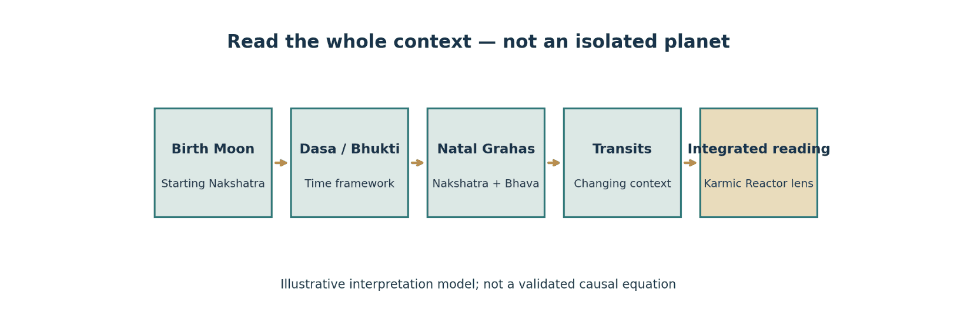
In the proposed integrated method, the practitioner begins with the Mahadasa and Antardasa but does not stop there. One must ask: where is the Dasa lord placed in the natal zodiac? Which Nakshatra and Pada does it occupy? Which Bhavas does it rule and influence? What relationships operate among the Grahas? How do contemporary transits relate to the natal configuration and the running period?
The Nakshatra of the Dasa lord deserves particular attention, but it is not the only determinant. Dasa, natal positions, house relationships and transits are complementary interpretive inputs. None should be treated as an isolated verdict.
8. History cannot be discarded
Imagine someone receiving a Nobel Prize. The distinction does not erase their secondary-school certificate or earlier record. A later rank makes sense only with reference to prior standards, accomplishments and history. The example reminds us that a new stage does not wipe out what has preceded it.
A refrigerator supplies another engineering analogy: sensing, control and cooling act as distinct but coordinated functions. The sensor does not have to describe the whole outside world for the feedback system to respond to changing conditions. Likewise, a holistic interpretation cannot be reduced to the name of the currently prominent Graha.
In the Karmic Reactor framework, Rahu and Ketu are analogous to forward- and rear-facing cameras associated with the Soul. They do not calculate, judge or announce karmic consequences. Those functions belong to the Karmic Reactor as the proposed evaluating system. The Mind experiences and learns; the Soul is distinct.
Venus at 27° Pisces provides an evocative closing image in this framework. Revati approaches the end of the zodiac before Aries begins again: the cycle may turn, but past transactions are not imagined to vanish.
Editorial continuity note:
Our earlier article (Why Rahu & Ketu, Though Shadows, Are Treated as Planets) used the term “karmic auditors.” The present research advances a refined analogy: Rahu and Ketu are observational interfaces, while karmic evaluation is attributed only to the Karmic Reactor. This is an evolution of the author’s research interpretation.
9. The arithmetic: exact relationships, modest conclusions
The arithmetic is valuable when kept precise. The complete zodiac is 360°; 27 Nakshatras multiplied by four Padas give 108; nine consecutive Nakshatras span 120°; and the nine traditional Mahadasa durations total 120 years. Separately, the seven sign-relative exaltation-degree numbers 10, 3, 5, 15, 20, 28 and 27 sum to 108.
The last sum is a numerical property of degrees measured separately inside different signs; it is not a physical zodiacal arc. Likewise 120° and 120 years share a number, not a proven conversion of angular distance into chronological time.
FIGURE 7. Key arithmetic correspondences. Equal numbers do not by themselves establish identical physical meaning.
Equal numbers do not by themselves establish identical physical meaning.
When the standard proportional Antardasa schedule is mapped across Krittika, the Moon’s 3° Taurus position aligns exactly with the Sun/Jupiter-to-Sun/Saturn subperiod boundary. Venus’s 27° Pisces coordinate aligns with the midpoint of Jupiter Antardasa within Mercury Mahadasa. Only these two of the seven exaltation coordinates show the specific boundary/midpoint matches selected here; Sun, Mars, Mercury and Jupiter do not coincide with such a selected boundary or midpoint, and Saturn is at a Nakshatra/Mahadasa start by definition. These calculations use the traditional durations as inputs and do not independently derive their origin.
At present we do not have a verified independent rule producing all nine unequal allocations. This limitation need not displace the main philosophical and practical purpose of this article.
10. The message and its benefit to readers
The value of this investigation is not another list of auspicious and inauspicious periods. It is an invitation to interpret life as an integrated journey. The Dasa clock can remind us to examine context, responsibility, history, effort and the condition of the whole system, rather than blaming one planet or awaiting another.
Our practical recommendation is simple: ask how the running Dasa, the Dasa lord’s Nakshatra, natal Bhava relationships and operative transits interact. Where appropriate, ask what can be learned, corrected, relinquished or pursued responsibly. Predictions should not replace evidence, judgment or agency in decisions concerning health, money, employment or relationships.
“Life is a package deal. No single Graha operates as an independent public-address system issuing good or bad verdicts. Vimshottari Dasa, in the Prashna Siddhi interpretation, is the map of the Soul’s journey through the world, read against a spiritual clock and the moving calendar of transits.”
Watch the Video Presentation
Watch K Jagadish explain Vimshottari Dasa, the Spiritual Clock of the Soul's journey, Nakshatras, and the Karmic Reactor:
Source channel video: https://youtu.be/caDPvVEGaGw
Frequently Asked Questions — Vimshottari Dasha Explained
How is Vimshottari Dasha calculated?
Vimshottari Dasha is calculated using the Moon’s exact astronomical degree at the moment of birth. The 360° zodiac comprises 27 Nakshatras of 13°20′ each, ruled sequentially by the nine Grahas. The Moon’s position inside its birth Nakshatra determines which Mahadasha is running at birth and how much of its duration remains (balance of Dasa).
What is the difference between Mahadasha and Antardasha?
A Mahadasha is the overarching major planetary period lasting between 6 to 20 years. An Antardasha (or Bhukti) is a proportional sub-period within that Mahadasha. The Mahadasha sets the broad environmental theme and karmic agenda, while the Antardasha activates specific events, relationships, and psychological shifts through the interaction of both ruling planets.
Why does Vimshottari Dasha cover 120 years?
The 120-year span represents a conventional complete theoretical cycle of all nine planetary periods. Numerically, nine consecutive Nakshatras span exactly 120° (one-third of the zodiac circle). It is not a rigid prediction that every person will live for 120 years, but a complete harmonic timetable for the unfolding of human consciousness.
Can a running Mahadasha alone determine life events?
No. In Prashna Siddhi, life is a package deal. No single planet operates in isolation. A running Dasa must be synthesized with the Dasa lord’s Nakshatra, Pada, house lordship, dignity, special aspects (Vishesh Drishti), and contemporary transits (Gochar). Judging a period purely as “good” or “bad” overlooks the larger karmic context.
How do Nakshatras, Pada Sandhis and transits contribute to interpretation?
Each Nakshatra contains four 3°20′ Padas, totaling 108 Padas in the zodiac. The Pada Sandhi (junction) marks a sensitive threshold where energy shifts from effort into realization. Transits provide the moving external weather against the natal chart’s static blueprint, indicating when latent potentials can materialize.
Research Note: Scope and Authorship
The zodiacal divisions, deep-exaltation coordinates and traditional Vimshottari periods are inherited from Jyotisha. The linked moral explanations, lighthouse metaphor and Karmic Reactor interpretation are proposed by Prashna Siddhi. Some numerical correspondences are exact; their historical or causal significance remains an interpretive research question.
Authorship and AI policy: The spiritual and philosophical research framework and original interpretative positions are developed and directed by K Jagadish of Prashna Siddhi. AI was used as a computational and editorial assistant for arithmetic checks, geometric exploration, graphic preparation, source discovery and drafting support. K Jagadish is responsible for the final interpretations, accuracy and publication decisions.
