Why Planetary Exaltation Was Never About Prediction
How Consciousness, Karma and the Zodiac Are Connected Through the Karmic Reactor
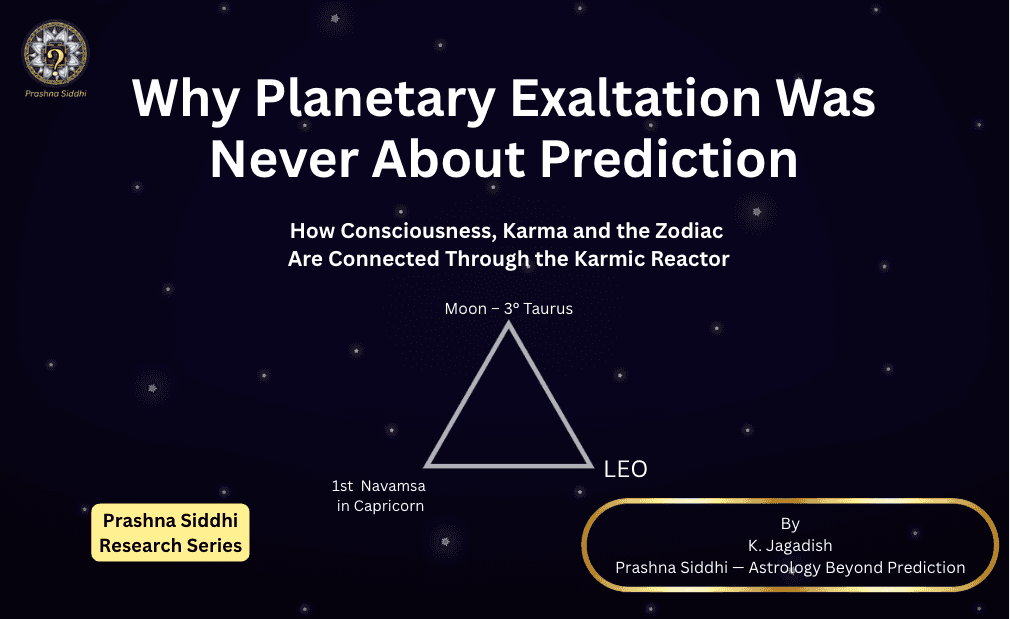
The Great Question
Looking at the phenomenon of planetary exaltation without a comprehensive understanding of Rashi Tatwa, Graha Tatwa and Bhava Tatwa is like driving a vehicle without brakes and without a roadmap. Naturally, we have no knowledge of our destination.
The next question is even more fundamental. Before attempting to understand exaltation of planets, we must first understand what the zodiac itself stands for and why it exists.
In our pursuit of worldly gain, we often forget the truth, sanctity and very purpose of the zodiac, together with the planets and the lunar mansion structure embedded within it.
Further, this universe is not the exclusive domain of human beings. Along with us coexist 84 lakh species, each participating in the same cosmic framework. Equally important, all the systems that govern our existence—science, technology, biology, weather, food production and survival itself—operate within a universal order.
The zodiac, therefore, cannot merely be a device for predicting wealth, marriage, career or material success. It appears to function as a universal operating system governing the relationship between consciousness, matter, action and consequence under precise and flawless cosmic laws.
"One may even call it the 'Constitution of God.'"
If this proposition is true, then planetary exaltation cannot simply be about worldly gains. Instead, it must represent a highly sophisticated framework of principles, procedures and outcomes governing the journey of consciousness itself.
This raises the greatest question of all:
Essential Queries:
- Was planetary exaltation ever meant for prediction, or was it always intended as a map of consciousness, karma and emancipation?
- Why is Moon exalted in the star of Sun?
- Why is Mercury exalted exactly at the centre of Virgo?
- Why is Venus exalted at 27° Pisces?
- Why are planets exalted only at specific degrees?
- Why are special aspects confined to only three planets?
- Why is Aakash Tatwa apparently missing?
- Why does retrogression exist?
The Biggest Mistake in Astrology
In our great hurry to find relief from the burning issues of life and to attain prosperity, we have, since time immemorial, looked at astrology through a myopic lens. We reduced the entire purpose of life to one word – gain – be it money, power, comfort, relationships, fame or authority, all viewed from the perspective of permanence, while knowing fully well that all living beings exist in a transitory and impermanent world.
Should we call this a mistake or a blunder?
Presuming, but never fully accepting, that our approach itself was driven by self-interest, should we not re-examine the method we adopted? We took the law of averages as the nucleus and began analysing social habits, human growth, needs, necessities and worldly achievements under one broad umbrella called Astrological Prediction. Gradually, astrology was transformed into a tool primarily intended for material prosperity.
For centuries, we applied statistical averages to planets, nakshatras and bhavas by studying millions of charts and correlating them with human experiences. This is almost equivalent to weighing ten individuals on a single scale, dividing the total weight by ten and then declaring that each individual weighs exactly the same. Such an approach can only provide an approximation of external reality and not the truth of the individual.
Human beings are not merely biological organisms. Fundamentally, they are cosmic entities. The union of twenty-three chromosomes from each parent initiates an extraordinary process within what we may call the Karmic Reactor, where the determining factor is not merely physical weight but karmic weight. Significantly, even modern science acknowledges that human beings are made of cosmic material, a fact popularly expressed by NASA as "we are made of star stuff."
Now observe the zodiac itself—its signs, planets, nakshatras and the exaltation of planets at precise degrees within specific signs. One cannot fail to notice that these are not arbitrary allocations but an intricately interconnected framework operating according to definite universal principles.
More importantly, the zodiac repeatedly points toward a profound route of emancipation through multiple mechanisms—planetary exaltation, special aspects, retrogression and even the apparent absence of a specific sign allocation for Aakash Tatwa.
Yet, despite this apparent omission, the Pancha Tatwas, Panchendriyas and twenty-five Prakritis continue to function in perfect harmony under the doctrine of karma and within the boundaries of the Dharma Trikona (1-5-9).
All these processes operate silently within the Karmic Reactor.
If uranium can be enriched in a nuclear reactor, then consciousness too can be enriched in the Karmic Reactor.
The Zodiac as an Electrical Architecture of Cosmic Law
This universe is traditionally called Karma Bhoomi, the field of action and consequence. Irrespective of whether we approach reality through astrology, spirituality, science or technology, one fundamental princitle remains inviolable:
In Physics
"Every action has an equal and opposite reaction."
In Cosmic Law
"Every force generates its corresponding balancing consequence."
Nothing in the universe appears to function outside this principle.
Now let us look at the architecture of the zodiac itself.
The seven visible planets have seven opposite points in the zodiac:
7 + 7 = 14
The three planets possessing special or enrichment aspects—Mars, Jupiter and Saturn—generate six additional aspectual fields together with their corresponding opposite fields:
6 + 6 = 12
Thus, the zodiac appears to operate through:
14 + 12 = 26 interacting cosmic fields
Interestingly, the successive addition of the number 26 gives us:
2 + 6 = 8
which corresponds to the special aspect of Mars, the planet representing action, effort and the force of manifestation.
Further, every planet traverses the zodiac according to a precisely defined orbit, speed and pattern. Nothing appears arbitrary.
From this perspective, human consciousness exists under continuous cosmic electrical interaction within what we call the Karmic Reactor, unlike the Nuclear Reactor where enrichment is achieved through the physical separation and concentration of uranium particles.
The Enrichment Principle:
Instead of the centrifugal separation of physical matter, consciousness enrichment requires the centripetal concentration of attention itself.
This singular concentration of consciousness, traditionally represented by the Shiva Netra or the Third Eye, may therefore be understood as the mechanism through which human beings transcend the continuous bombardment of the external world and move toward higher states of awareness.
Exaltation as a Spiritual Framework
Vedic astrology defines planetary exaltation as the peak potential of planetary energy. However, when viewed through a spiritual lens, each planet's exaltation reveals a profound step in the evolution of consciousness:
| Planet | Spiritual Message |
|---|---|
| Moon | Mind toward Atman |
| Sun | Soul entering Karma as per past record |
| Jupiter | Dharma and justice |
| Saturn | Discipline and accountability |
| Mercury | Refinement of consciousness |
| Venus | Contentment, peace of mind and tranquillity |
| Mars | Conquest of ego |
Why Aakash Tatwa Is Not Missing
Among the Pancha Tatwas, Aakash Tatwa (Space) alone has no direct physical representation in the zodiac. This is not a lacuna or omission at all. On the contrary, it appears to be a profound statement.
Ironically, the most critical elements sustaining life often have no physical form that can be directly perceived. Consider oxygen itself. It is indispensable for life, yet it remains invisible to our physical eyes. We do not see oxygen, but we continuously experience its presence through its effects.
Likewise, Aakash Tatwa appears to be unrepresented in the zodiac only because it is not intended to represent a physical principle. Instead, it functions as the universal sustaining medium enabling the operation of the Pancha Tatwas and the Panchendriyas.
From a scientific perspective, one may draw a broad parallel with the neurological and motor control systems originating in the brain and mind, where the effects are observable while the originating intelligence itself remains elusive. Thus, Aakash Tatwa may be understood not as a physical substance but as an ethereal principle governing intelligence, discretion, consciousness and free will.
As already noted, NASA has stated that human beings are fundamentally made of cosmic material. Modern biology further establishes that every human body arises from the union of twenty-three chromosomes from each parent, leading to the formation of a biological organism.
An Astronomical Numeric Reflection:
23 + 23 = 46 → 4 + 6 = 10 → 1Viewed as 1 and 0, it immediately evokes the binary foundation of modern digital systems and computing. At another level, the number 1 also symbolizes unity in contrast to diversity and, in spiritual terms, the eventual return of consciousness to its source.
How Does Mercury Come Into the Picture?
As discussed in Chapter 7 of 9 on the Exaltation of Mercury, Mercury is the principal significator of intellect, wisdom, discrimination and conditioned free will.
Mercury occupies a unique position. It is the planet closest to the Sun and, in terms of zodiac architecture, is intimately connected with both the expression and refinement of consciousness.
Unlike the other planets, Mercury becomes retrograde very frequently. Other planets generally become retrograde when the Sun transits five signs behind them and regain direct motion when the Sun reaches the ninth sign from their position, thereby operating within the framework of the Dharma Trikona (1-5-9). Mercury, however, behaves differently.
This frequent apparent retrogression of Mercury may be viewed as a continuous process of refinement, correction and adjustment—a cosmic mechanism for fine-tuning intelligence itself.
Mercury therefore appears to function as a cosmic interface distributing intellect, discrimination and wisdom, always within the boundaries of the Dharma Trikona principle of 1-5-9.
Nothing in the universe appears to function outside this framework.
Human intellect itself is highly flexible, volatile and contextual. Human beings apply wisdom, logic and discrimination differently depending on circumstances, experience and necessity. Perhaps this very flexibility and dynamic balance constitute the essential nature of Aakash Tatwa.
It may therefore be no coincidence that Mercury is exalted in its own sign Virgo at precisely 15°, the exact midpoint of the sign, in the star of the Moon—the planet representing the mind itself.
Mercury: The Cosmic Interface
Mercury, being the planet closest to the Sun, the significator of Atman or the Soul, becomes retrograde very frequently. But does Mercury physically move backward?
The answer is no.
In fact, no planet physically moves backward at any time. Then why was the phenomenon of retrogression identified and who witnesses it? The answer requires a careful understanding of both astronomy and the architecture of the zodiac.
A brief excursion into astronomy will help us.
All planets revolve around the Sun. The Earth itself is a planet of the Solar System and revolves around the Sun. The Moon, however, revolves around the Earth and thus occupies a unique position in relation to human life and consciousness.
The phenomenon of retrogression is purely an observational phenomenon from the perspective of the Earth. From our earthly standpoint, planets appear to slow down, become stationary and move backward due to the relative motion of the Earth and the planets around the Sun.
Interestingly, most planets become retrograde when the Sun occupies a position approximately five signs behind them and resume direct motion when the Sun reaches approximately the ninth sign from their position. This remarkable pattern appears to synchronize with the functioning of the Dharma Trikona principle of 1-5-9 and the doctrine of karma.
Mercury, however, is an exception.
Because of its close proximity to the Sun, Mercury enters apparent retrogression much more frequently than the other planets. This phenomenon itself is not physical but observational. Curiously, many of the most important aspects of human existence are also non-physical:
- • The Soul
- • Karma
- • Free Will
- • Thought
- • Desire
- • Memory
- • Imagination
- • Consciousness
All of these are fundamentally connected with the mind, represented by the Moon, the fastest-moving celestial body in the zodiac.
The role of the Moon in the context of Aakash Tatwa becomes highly intriguing.
The Moon takes approximately twenty-seven days to traverse the twenty-seven Nakshatras. From the perspective of the Karmic Reactor, the Moon functions as a continuous transmitter and receiver of the twenty-seven Nakshatras. Thus, the human mind remains under uninterrupted cosmic interaction throughout life.
At any given moment, according to the Karmic Reactor framework, human consciousness is subjected to the influence of twenty-six interacting cosmic fields, whether one is awake or asleep.
Mercury, being the planet closest to the Sun and the principal distributor of intellect, wisdom and discrimination, continuously interacts with the Moon. It is therefore significant that Mercury is exalted at precisely 15° Virgo, the exact midpoint of the sign, in Hasta Nakshatra ruled by the Moon.
From this perspective, Mercury may be viewed as the cosmic interface of Aakash Tatwa, constantly available to guide, refine and correct human consciousness.
In everyday life, this phenomenon is experienced naturally. If an intruder enters a house in the middle of the night, the body's self-preservation mechanism responds automatically, often before conscious reasoning takes place. Such instantaneous responses suggest the operation of an intelligence that functions beyond ordinary conscious thought.
The phenomenon of planetary exaltation may therefore represent something far more profound than material success or worldly gain.
Since the Moon is the primary reference point for human life on Earth, many traditions have naturally adopted Chandra Lagna as an important predictive framework. However, an equally profound fact is often overlooked:
"The Moon itself is exalted at 3° Taurus in the star of the Sun."
This single fact may fundamentally alter our understanding of the relationship between mind, Soul and the ultimate purpose of the zodiac itself.
Why Does Mercury Become Retrograde So Frequently?
Unlike the other planets, whose retrogression broadly follows the framework of the Dharma Trikona (1-5-9), Mercury is an exception because of its close proximity to the Sun.
If the Sun is viewed as the Constitution of the Universe, then Mercury may be viewed as its Chief Executive. A constitution defines principles, whereas administration must remain flexible and adapt to circumstances while remaining within the constitutional framework.
The human mind has often been compared to a monkey because of its restless and unpredictable nature. Such a mind cannot be governed by rigid rules alone; it requires continuous refinement, correction and guidance. This appears to be one of the fundamental purposes of the zodiac itself.
From this perspective, Aakash Tatwa can never be fixed in quantity, quality, duration or circumstance. Yet all these variations operate within the immutable framework of the Dharma Trikona—1, 5 and 9—ensuring a precise and individualized cosmic delivery system for every living being.
Memory, Logic and Intelligence
Memory, logic and intelligence are contextual, need-based and situation-dependent. None of these faculties remain permanently fixed. Perhaps this is precisely why Aakash Tatwa has no dedicated zodiac sign. Life itself demonstrates that the most critical aspects of existence often have no direct physical representation.
This also explains why concentration of mind becomes so important. The more concentrated the mind, the more effectively intelligence, memory and discrimination can operate.
Unity Against Diversity – The Cosmic Binary
One of the most fascinating features of the zodiac is the relationship between Unity and Diversity.
The Soul or Atman is one and indivisible, whereas the manifested universe consists of multiplicity and diversity. If the Soul is represented by the number 1, then the zodiac unfolds into a vast network of relationships and interactions.
As discussed earlier, the zodiac continuously operates through twenty-six interacting electrical fields:
2 + 6 = 8 (Mars' aspect)
Equally intriguing is the fact that Mars attains exaltation at the highest degree—28°:
2 + 8 = 10 → 1
Thus, diversity ultimately returns to unity. From another perspective, the numbers 1 and 0 form the foundation of the binary system that powers the entire digital world.
Mercury – The Only Metal in Liquid Form
Mercury occupies a unique position even in the physical world. It is the only metallic element that remains liquid at ordinary temperatures. It is electrically conductive, highly sensitive to temperature variations and yet, paradoxically, potentially poisonous.
Many phenomena in nature appear to symbolically reflect their own essential characteristics.
Consider a drop of liquid mercury released on a surface. Instantly, it fragments into numerous smaller droplets which disperse rapidly and become difficult to recover completely.
This behavior bears a striking resemblance to the activities traditionally associated with Mercury:
- Intelligence & thought patterns
- Memory and communication systems
- Analysis and adaptability
- The rapid dispersion of information
From this perspective, the binary architecture underlying computers, digital technology and artificial intelligence may be viewed as technological manifestations of principles symbolically represented by Mercury.
Likewise, the extraordinary transmission of information within the human nervous system and the operations of memory, logic and intelligence become less surprising when viewed through the broader framework of consciousness.
The remarkable developments of modern digital technology and artificial intelligence may therefore be understood not as contradictions of ancient wisdom, but as contemporary demonstrations of principles that have long been contemplated in philosophical and spiritual traditions.
Karmic Reactor and Consciousness Transformation
It is ironic that, in practical life, we chase solutions in countless ways while the root of the problem often remains invisible or conceptual. In astrology too, the zodiac—a symbolic representation of planets, nakshatras and cosmic principles—remains a conceptual framework, yet its effects are experienced by us every day. This apparent contradiction creates confusion unless we understand the foundations properly.
For that matter, Karma itself is an invisible principle. It is a matter of faith, belief and lived experience. To prove Karma in a laboratory setting is almost impossible. In our modern, proof-based digital world, this presents a significant challenge. Therefore, we are compelled to rely upon reason, logic and experience.
Consider a very simple example from our daily life—petrol, one of our most essential requirements. Very few people pause to consider its true origin. The proposition that petrol originates from once-living organisms that existed millions of years ago appears difficult to comprehend, yet this remains the prevailing scientific explanation. Readers may refer to our E-book Petrol from the Dead, which explores this subject in greater detail.
Likewise, the human body itself is an extraordinary gift of creation, yet we understand very little about its deeper purpose, the role of Karma and the philosophical principles governing existence.
Although we place great faith in science, the roots of science itself lie in philosophy. This is often overlooked. Consider the formation of human life itself: the union of twenty-three chromosomes from each parent initiates an astonishing biological and atomic process, followed by a gestation period of approximately nine months. Equally intriguing is the scientific proposition, popularized by NASA, that human beings are fundamentally composed of cosmic material.
Returning to the concept of Karma, we find ourselves confronting an invisible principle that nevertheless manifests continuously through daily experience. The underlying mechanism may remain debatable, but human beings are ultimately compelled to rely on faith, belief, reason and intellect to navigate existence.
We know that uranium can be enriched in a man-made nuclear reactor to generate enormous power, which may then be deployed either constructively or destructively. By analogy, human consciousness too can be enriched through discipline, accountability and conscious effort by utilizing the principles embedded within the zodiac.
From this perspective, planetary exaltation, Pancha Tatwas, retrogression, nakshatras and the special aspects of planets collectively provide a framework for the enrichment of consciousness.
It is for this reason that I have called this framework the Karmic Reactor.
Unfortunately, astrology has largely been viewed for centuries as a fortune-telling mechanism. Practical human experiences were recorded through a narrow lens of material gain and loss, while the deeper architecture of the Karmic Reactor—the roadmap toward emancipation—remained largely unexplored.
Yet the truth appears to be that the zodiac is not merely a predictive device. It is a map of consciousness, capable of facilitating transformation and, ultimately, transmigration from one form of existence to another.
As discussed earlier, the apparent non-representation of Aakash Tatwa in the zodiac may itself be explained through the role of Mercury and its frequent apparent retrogression. Mercury possesses the unique ability to establish connections among memory, logic, cause and effect, need and greed, and rapid decision-making.
Mercury's extraordinary speed, adaptability and capacity for information processing bear a striking resemblance to the functioning of modern artificial intelligence and the binary architecture underlying contemporary digital systems.
Thus, the extraordinary developments of modern science, computing and artificial intelligence may not stand apart from the principles discussed here, but may instead represent practical demonstrations of them.
Pillar Conclusion
"The Karmic Reactor is not a mechanism for predicting events. It is a framework for regulating, refining and enriching consciousness through the creation of awareness."
Prediction is merely a by-product of understanding the Karmic Reactor; consciousness transformation is its true purpose.
Summary Key Points
- Consciousness Evolution: Planetary exaltation in Vedic astrology may not merely indicate material prosperity, power or success, but may represent a framework for consciousness evolution and spiritual emancipation.
- Zodiac OS: The zodiac appears to function as a universal operating system governing consciousness, karma, action and consequence under precise cosmic laws.
- Cosmic Architecture: The conventional predictive approach to astrology may have overlooked the deeper philosophical and spiritual purpose of the zodiac. The phenomenon of planetary exaltation at precise degrees suggests the existence of a highly structured and interconnected cosmic architecture.
- 26 Interacting Fields: The zodiac may be viewed as an electrical architecture consisting of 26 interacting cosmic fields continuously influencing human consciousness.
- Consciousness Enrichment: Planetary exaltation, special aspects, nakshatras and retrogression may collectively function as mechanisms for consciousness enrichment.
- The Etheric Element: Aakash Tatwa is not necessarily absent from the zodiac; rather, it may operate as an invisible principle governing intelligence, free will, wisdom and consciousness.
- Mercury Connection: Mercury, being closest to the Sun and frequently retrograde, may function as the cosmic interface connecting Soul, mind, intellect and consciousness. The frequent apparent retrogression of Mercury may represent continuous refinement and fine-tuning of intelligence within the framework of Dharma Trikona (1-5-9).
- Stellar Interaction: The Moon may function as a continuous transmitter and receiver of the twenty-seven nakshatras, keeping the human mind under constant cosmic interaction.
- Binary Parallels: The principles underlying modern digital systems, binary logic and artificial intelligence may bear symbolic similarities to principles represented by Mercury and the zodiac.
- Enrichment Process: Uranium enrichment in a nuclear reactor and consciousness enrichment in the Karmic Reactor may represent analogous processes operating at different levels of existence.
Frequently Asked Questions
Question 1: What is the real purpose of planetary exaltation in Vedic astrology?
Planetary exaltation may not merely indicate material success or prediction. It may represent a framework of consciousness evolution, karma and spiritual emancipation.
Question 2: Why is Mercury exalted at 15 degrees Virgo?
Mercury is exalted at the midpoint of Virgo in the Moon's star Hasta, symbolizing refinement of intelligence, discrimination and consciousness.
Question 3: Why is Moon exalted in Taurus in the star of the Sun?
Moon exalted in the Sun's star suggests that the mind ultimately has to align with the Soul or Atman.
Question 4: Why is Aakash Tatwa missing from the zodiac?
Aakash Tatwa is not physically represented because it is an ethereal principle governing intelligence, consciousness, free will and wisdom.
Question 5: What is the Karmic Reactor?
The Karmic Reactor is a conceptual framework describing the interaction of karma, consciousness, planetary principles and human evolution.
Question 6: What does Mercury retrograde represent spiritually?
Mercury retrograde may symbolize refinement, correction, introspection and the operation of consciousness through Aakash Tatwa.
Question 7: Is astrology only about prediction?
Prediction may be only one application of astrology. The zodiac may also function as a map of consciousness and spiritual evolution.
✍️ The Editorial
Astrology, particularly in the earlier periods of civilization, was perhaps regarded as a sacred and devotional science, deeply rooted in philosophy and spiritual enquiry rather than material or commercial considerations. Its primary purpose appears to have been the harmonious alignment of human life with divine principles and cosmic order.
Over the course of time, however, the emphasis gradually shifted toward material gains and worldly prosperity. Consequently, astrology increasingly came to be viewed as a predictive mechanism capable of conferring luck, wealth, power and success, often overlooking the deeper purpose and intent of the zodiac itself.
The zodiac, however, appears to function within the immutable framework of the Dharma Trikona, governing all forms of life and consciousness on Earth. As astrological practice evolved, the growing emphasis on yogas, combinations and empirical observations derived from birth charts gradually transformed astrology into a practical rule-book of material expectations.
In this process, we may have unintentionally overlooked its more profound dimension—that the zodiac is not merely a predictive framework, but also a map of consciousness and a roadmap toward emancipation.
Consequently, several critical concepts of Vedic astrology, including planetary exaltation, special aspects and retrogression, may have gradually drifted away from their original philosophical and spiritual context.
This article is a sincere attempt to encourage readers to revisit some of the most frequently used concepts in astrology and reflect upon their deeper meaning and purpose. It is not intended as criticism of any individual, school or tradition, but rather as an invitation to explore the possibility that the zodiac may represent a far more comprehensive framework of consciousness, karma and spiritual evolution than we have generally assumed.
Related Research & Semantic Hub
Expand your exploration of the Karmic Reactor and the science of the soul through our interconnected research publications:
